In the course of compiling a history of the results of senior men's football competitions in Victoria (for draft click here) I've also started a few files for other relevant information. One such file is a list of the bodies and committees governing of the game in this state, which can be found here:
https://www.dropbox.com/s/cm4nx9j04jtpri0/Officials.rtf
From early newspaper reports I have included the names of any people awarded life membership of any such body. In later years the Victorian Soccer Federation Yearbooks contained a current list of life members, and I have included any people added each year since the initial list published in 1968. When I say current, I mean the Yearbook lists those able to enjoy the privileges of life membership i.e. those still alive. Names do drop off the Yearbook lists, and I'm assuming that's because those that have passed away no longer being included rather than people having been stripped of the honour.
Obviously life memberships of the VSF were often awarded to those that had worked in the service of the organisation. Which is totally understandable, but leads to an imbalance. The VSF may have run the game, but they did not own it. It would have been nice if a few more people from outside the organisation were awarded life membership in honour of their service to the sport.
We know the AFL automatically confers life membership on those that have played or coached a combined 300 games. This has avoided what happened with VSF life membership, which is top heavy in VSF officials and light on for players, coaches, referees and those who's work as officials was restricted to club duties as opposed to being involved in VSF politics.
It's a shame more of these people weren't given life membership. It's a massive oversight that all Victorian-based members of the 1974 World Cup Finals Socceroos squad were not instantly given membership (sure Peter Ollerton would had to have had his stripped after he assaulted referee Jim Fearn). The likes of Billy Vojtek and Jimmy Armstrong should surely have been included. Referees like Eugene Brazzale, Gerry Connolly or Dennis Voutsinas too.
This week, the Football Federation Victoria called upon nominations for life memberships for new inductions to be made at the upcoming Annual General Meeting. Whilst honouring people for their efforts is good, restoring the honour to previous life members would be better. There is no list of those awarded life memberships on the FFV website. Is their any prestige to an award where one can be forgotten about so quickly? It seems like a lack of respect to me.
Has the FFV Hall of Fame overshadowed those that have received life membership? Hall of Fame inductees get a mention on the FFV website, whilst the names the life members must rest in an unmarked grave somewhere.
Would it be too difficult for the FFV to add a page to their site to truly honour their life members? The names, dates of birth (and death for those that have passed) of recipients and perhaps a brief line describing what the did for the game should not be too hard to muster. If anyone actually cared, that is.
Until the memory of former life members are given due recognition, should we consider present inductees as being put through an exercise in lip service and a token effort at thanking them for their services? If the FFV is genuine in respecting these people, it needs to do more.
Wednesday, 5 February 2014

Wednesday, 29 January 2014
What I Learned Last Week...
from my visit to the State Library of Victoria. Firstly, maybe I was a bit optimistic in thinking a decent chunk of the senior league tables can be obtained. Second Division results in the 1920's a very sporadic, and sources are limited as The Sun and The Sporting Globe didn't kick-off until 1922 and 1923. Not getting very far in finding out more about the 1919 Dockerty Cup Final either.
Better luck with 1929. Worked out the complete Second Division table. With a 14 game season, I have the full results of half of the teams in Division Three, with only Richmond (12), Pascoe Vale (12), Coburg (13) and Camberwell (13) having results missing. Still more work to do on Division Four, where I have one team with the full 14 games, one with 13 accounted for, 5 on the dozen and one on eleven. Found announcements for the winners of the First and Third Division Reserves competitions, but tallying up the known results of the Second Division Reserves does not get close enough to resolving that issue.
Back to The Winner. It's first came out on July 29, 1914. It was done and dusted during 1918. Following the outbreak of the First World War, Victorian soccer battled though a season in 1915 before dwindling numbers saw competitive football come to an end in 1916. That year, soccer correspondent J.W.Harrison covered the minor Aussie Rules competition that was the Victorian Junior Football Association (which competed for the John Wren Shield). A football man to the core, he'd still squeeze in some soccer news if it was available, namely the results of friendly games between the Army and Navy or other scratch matched played at Middle Park.
I haven't mastered (actually even attempted) taking hard copies of what I come across on the microfilms yet, planning on learning that after I have completed as much result gathering as I can. So without being able to produce samples, here are some interesting things I found:
August 12, 1914 edition, page 7 - a picture of the original Victorian soccer committee from 1907.
October 7, 1914 edition, page 7 - a picture of the St Kilda team, played 18, won 9 lost 5 drawn 4.
October 21, 1914 edition - 597 registered players in the VABFA, and during the year H.L.Dockerty was presented with a Life Member's Badge, probably the first such honour in our history.
November 11, 1914 edition, page 7 - pictures of the Northumberland and Durham United and Melbourne Thistle teams.
April 28, 1915 edition, page 8 - a list of "players who responded to countries call".
May 19, 1915 edition, page 7 - individual pictures of the brothers T.E., A.H. and H.M.Lowe.
June 23, 1915 edition - news that H.M. (Hughie) Lowe was killed in action in the Dardanelles.
August 11, 1915 edition, page 7 - pictures of the England and Scotland teams from the Local International.
September 15, 1915 edition, page 6 - early picture of the Dockerty Challenge Cup.
Finally, can you imagine 20's-30's Moonee Ponds playing games at Moonee Valley Racecourse? They'd be able to have night games there nowadays.
Wednesday, 22 January 2014
Highs and Lows of History Research
After two successive Sunday's at the State Library of Victoria looking through on newspapers on microfilms, more steady progress has been made on the epic (it's up to 200 pages now) journal. The latest draft can be viewed here:
https://www.dropbox.com/s/ru1oas24op99izx/VictorianFootballStatisticalHistory.5.pub
The usual frustrations remain. How hard is it to publish a league table at the end of the season? No table, okay, I'll get the results and compile my own. Not all the results published, okay this is hopeless.
Just when you feel like packing it in, along comes something to lift the spirits. This week it was The Winner. A weekly sports newspaper that the was around during the years of the First World War. It was late in the day when I decided to give one of the six microfilm rolls a go, and I will be back to have a further look.
Now "sports" newspapers in those days could be pretty varied. For some the only sport was horse racing, not much more than form guides. Some were about eighty per cent horse racing, ten per cent Australian Rules Football and ten per cent other sports. The Winner seems to have adopted more of a 60-20-20 split.
The football writer for The Winner was J.W.Harrison. I have not seen his name in any subsequent publications, which was a shame for he was rather good. He also occasionally was able to get photos to accompany his pieces, including one of the Dockerty Cup as well as team shots of the leading clubs.
Returning to the things doing your head in angle, 1923 has been a big source of that. Strange doings were afoot in the First Division that season. It was a time before goal difference had been accepted as the means of splitting teams level on points. With St Kilda and Footscray Thistle heading the table together, a Play-Off was undertaken to determine the League Champion. After a second replay, it was the Saints who took the honours.
The drama came with the two teams to be relegated. Northumberland and Durham United were gone, adrift at the foot of the table, but above them Windsor and Melbourne Thistle finished level on points, so a Play-Off was also required to determine the second relegated side. Come match day, the appointed referee failed to turn up. After discussions an acceptable fill-in referee was agreed to, but when it came time to go out and play Thistle now refused to accept the substitute ref. Windsor went out, the ref blew the whistle, Windsor took the ball up the park and put it into the empty net, but you didn't need someone from TAB Sportsbet to tell you to "hold all tickets". Obviously there was a protest during the week, and they all went back to have another crack a week later, with Windsor emerging 2-1 winners.
So the bit that does the head in? The next year Melbourne Thistle was still in the First Division and Windsor were in Division Two? Why? Where is the explanation? Was there another protest? No evidence of another replay. The papers tell us nothing. Chances of finding closure look slim. Another low.
Wednesday, 8 January 2014
Back to Business
Progress on "The Victorian Football Statistical History" remains steady. The new draft has the titled amended, with the 1909-1979 removed. Even put in a cover, well, wrote THE VICTORIAN FOOTBALL STATISTICAL HISTORY in a massive font on the first page with a view to putting a few pictures around it.
1911, 1912, 1926, 1932, 1941, 1976, 1977, 2010, 2011 and 2013. Those are the seasons which I have all the information I need to complete their pages. That's means there are still 92 years incomplete. A lot of them in modern times where such information should be readily available at the click of a mouse.
What information do I want to consider a season complete? Obviously final league tables for the senior leagues. I have something for each year of what is now the Victorian Premier League. There are some years where lower league tables are lacking, but I still believe enough information can be found to complete the task.
The full details of all the Dockerty Cup Finals is the next aim. Date played, venue, referee's name, result and scorers and both team line-ups are what that entails. Though gaps have narrowed, I fear there will be a year or two where the team line-ups cannot be found. Probably the referee's names as well, but I won't cry about that. But if I get down to just one or two years with no team line-ups, it will burn.
After that come the Reserves (later Harry Armstrong) Cups and the other senior Cup Final scores and scorers. This is still very sketchy, especially in the Cup crazy 1970's, when there was the Ampol Cup, State League Cup, Federation Cup, Cumberland Cup, Provisional League Cup and District League Cup at times. The results for the last four frustratingly come and go.
I'm not including tables for the District/Amateur League, but would like to list the champions of each division along with the champions of the various reserves leagues. Again this information is still somewhat patchy.
A few breakthroughs were made recently. In previously looking at the results from 1923, the lower league picture was very murky. Complications faced including the usual issue of not all the results being published in a paper, let alone regular league tables. In some cases there was mention of a Third Division, but more often it was called the Reserves League. Now back then reserves teams were not compulsory, and often clubs with a reserves team fielded them as an "A" teams playing in a league against standalone senior clubs. So there may be still some debate as to whether this was a Third Division or a Reserves League. Either way, tallying up the results produced an unwieldy mess, more teams than made sense all having played too varying numbers of games to persist in trying to work it out. The breakthrough? Finding out that it was actually divided into an A and B section, therefore two different leagues. Why the fuck this couldn't have been mentioned in the results section every week I do not know.
Once I've narrowed down a season to a vital result or two, some of the suburban newspapers on Trove have come in handy. The Footscray papers gave good coverage in the initial years, even after the club changed it's name to Northumberland and Durham United. When Footscray Thistle came along both clubs had coverage, as did Sunshine United and Sandringham at times.
Trove and it's online newspaper archive is about to add The Australasian to it's collection, there may be something there. Then it will be a winter of visits to the State Library.
Thursday, 28 November 2013
Old Soccer News
Not as in Old Soccer/New Football. And not as in news updates that are out of date. Instead, let's look at some old copies of Soccer News, the Official Organ of the Victorian Amateur Soccer Football Association back in the day.
There's been a small sample available on-line for a few years at the magnificent Australian Online Football Museum site, specifically at this link.
I've uploaded a few issues myself, like this one:
http://www.scribd.com/doc/187739131/Soccer-News-1952-October-4
The Dockerty Cup Final edition of 1952. A beauty with several team shots of the League winners for the season, as well as the Cup finalists and pen portraits of the players in the Final.
Then there is:
http://www.scribd.com/doc/187738398/Soccer-News-1951-August-25
In the editorial V.J.M.Dixon looks at the problem of the lack of enclosed grounds, whilst club jottings include news from Brighton, Frankston, Polonia and Fifers.
I've also got three issues from the end of the 1949 season:
http://www.scribd.com/doc/187735817/...9-September-10
http://www.scribd.com/doc/187736434/...9-September-17
http://www.scribd.com/doc/187736988/...9-September-24
An exciting time leading up to the Dockerty Cup Final, and a must read for those at the FFV who slowly seem to be coming around to embracing the Dockerty name once again. You can see what it once meant, and hopefully a revival can regain some of the former prestige.
Thursday, 21 November 2013
It Just Ain't Right
Progress on the Statistical History of Victorian Football remains slow but steady. I found a few more Best and Fairest winners and Top Goalscorers lists in the Annual Reports archive on the FFV website, but a gap still remains between the end of the VSF Yearbook era and the start of the current FFV's results system a couple of years ago.

In adding all the new tables to the project, the 2013 ladders for the various State League Division Fives had me shaking my head and mumbling the title of this blog post over and over again.
State League Division Five North had 14 teams competing. Division Five West had 16. Division Five South had 14 and Division Five East comprised of 15 teams. I will now digress for a moment.
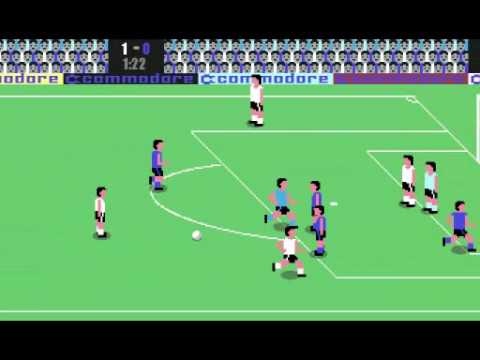
The above is a picture of the classic Commodore 64 game, International Soccer. It came not on a CD, or a disc, or even a cassette tape, but on a cartridge inserted into a slot in the primitive early "home computer". Graphics were chunky, and the screen did not allow for a full team of eleven, but it was football.
Unlike modern games, the options were limited. You could play a game against the computer or a human opponent and that was about it. It did not run a league for you, which is where I start to bring this back around to the point.
When I was a young 'un, I ran my own International Soccer league. We all had two teams each to make an eight team league, the clubs named after ourselves (Markham Hotspur took the title). I typed up a results and ladder sheet on an olde fashioned typewriter, which had a ribbon of ink. To do the fixtures I took a blank piece of paper, and wrote 1v2, 3v4, 5v6 and 7v8 on it. I then rotated the numbers for each round, and then reversed the fixtures. Assigned a team name to each of the numbers and that was that. It was not rocket science, even for a Year 7.
Now in an eight team league, if everyone plays each other once home and away, it gives you a fourteen game season. If you have twelves teams in your League, it's a 22 game season. So when I looked at the number of games played in the State League Division Fives this season, only 22, I knew it just ain't right.
In football/soccer a league season involves every team playing each other once both home and away. Anything else just ain't right.
To be the Champion, you are the team that sits atop the table AFTER every team has played each other twice. If some teams didn't play each other twice, it just ain't right. Promotion and relegation is unfair should every team not play each other twice, because it just ain't right.
The VPL season of 2007 wasn't right either.That was because the introduction of the AIS and an administrative error from the FFV leaving it prone to legal action from whomever it relegated out of Sunshine Georgies or Essendon Royals left the competition with an extra number of teams in a time of drought which hindered the ability to start the season earlier. It still was not right.
The FFV does the game and clubs a disservice by restricting competitions with 14, 15 and 16 teams to a 22 game league season. A league competition is not fair unless each team players the others twice. It goes against the Integrity section of their stated Core Values, which reads:
Integrity - The affairs of the FFV will be unconditionally embedded in honesty and fairness.
In an effort to make their competition more fair, the clubs of State League Division Five East Reserves opted to play each other just once. I hope they got a discount in their affiliation fees for their rather short 14 games season, as that would only be fair.
Surely the FFV could start the season for these league earlier, or extend them to allow for the extra two, three or four rounds to make the competitions fair? Everyone knows the AFL game has a compromised draw, but there is no need for the FFV to copy them in limiting leagues to a 22 game season. Our football is a game where plenty of clubs around the world can play two games a week for periods of time, unlike the AFL which is restricted to a 22 game regular season by their Player's Association.
There is plenty of time for the FFV to sort out this situation for next season, hopefully they will make it right and make the competition fair for everyone.
Wednesday, 13 November 2013
The Statistical History
Again another long gap between blog posts. You may remember last time I mentioned the historical record document I had started a few years ago.
Here's the link again to the MS Publisher file for what was then the grandly titled "Victorian Football Statistical History 1909-1979". I'm trying to get all the final tables for the senior men's leagues for each year since regular league competitions began in Melbourne in 1909. The wider column on the left has the tables, the narrow one to the right the results of Cup Finals (line-ups if possible for the major Cup of the day) and then Leading Scorers, Best and Fairest Award Winners and Reserves League Champions as they were introduced.
https://www.dropbox.com/s/cx2j0mqd5mn1zmd/VictorianFootballStatisticalHistory.2.pub
Since the last post, I have decided to remove the 1979 conclusion and bring it up to the current day. I already had most of the tables typed up in the template I have for them up until 2006, so some typing was involved. As time consuming as this was, it paled into insignificance compared to the time spent ascertaining the information for the right hand column.
Despite being in the Internet Age, on the information super highway the FFV is pulled over, broken down in the emergency stopping lane. Searching for some of these details is no easier than it is for stuff from 1909, when football was "British Association" and a clear poor relation to the other codes.
The FFV has changed website providers and results systems a few times, and archiving has not been a priority. With the final VSF Yearbook having been published in 2000, that is where the recorded lineage of a lot of this information ends.
From the old VSF Yearbooks we know that Maurice Payne of South Yarra won the first Medal for best player in the First Division in 1954. Back then it was The Argus Medal, later the Rothman's Medal and various other sponsored names before simply becoming the Gold Medal. It remained the premier award as the First Division became the State League and then the Premier League. In 1970, Jim Dale of Heidelberg won the first Metropolitan League Best and Fairest Award, repeating the dose in 1971. When Les Gooney of Eltham took the honour in 1972, it was the last time that award was determined by one winner from all four divisions. In 1973 each Metropolitan League division had it's own Best and Fairest. The history of the Provisional League Best and Fairest Award starts in 1983 according to the records in the VSF Yearbooks.
So who were the Best and Fairest winners in the State and Provisional Leagues in 2007 or 2008? Great question, don't have the answer. It's hardly ancient history, but it may as well be. It's a damning indictment on the FFV that it's archives are restricted to the last two seasons though league tables and results going back to 2006 can still be found on a link to the old ResultsVault system.
Compare
http://www.efl.org.au/index.php?id=307
to
http://www.footballfedvic.com.au/index.php?id=history
and ask yourself could the FFV do better?
Subscribe to:
Posts (Atom)