In Australian football the phrase "I told you so" is now synonymous with the late, great Johnny Warren. Sadly there are too many instances where it can be used in looking at the foolish errors made by those who administer the game in this state.
One would be the Whittlesea Zebras debacle of 2009. Taking sides with ousted President Sam Cuteri, the FFV saw to it that the Zebras were left homeless at the start of the season by listing their venue as "to be confirmed" in the VPL fixtures. When the FFV should have stood by it's member club, it tried to assist one of it's sponsors in getting the club evicted instead. When the matter went to court, the Zebras were reinstated as tenants of Epping Stadium and the Federation took a financial hit for their troubles.
For the Zebras the damage was done. A pre-season of trying to source grounds to train on leading to players on occasion only getting text message notification of that evening's venue early in the afternoon was a major setback. As was playing home games at their opponent's venues. It all took it's toll and the Zebras were duly relegated.
One would think that the FFV could have been told that council's generally issue ground leases to clubs rather than individuals which would have avoided this shameful episode. When pondering why the FFV took the path it did, it is mainly the C-word that comes to mind, that being corruption.
Once again the FFV was headed for the courts last year, as a coalition of clubs challenged the way it was implementing the NPL in the state. In early November it declared on it's website that as a result of that action, that there would be no NPL in Victoria in 2014. That's the NPL that was won by South Melbourne a few weeks ago. Most people with a clue knew that despite the dramas the NPL would be implemented this year, which leaves us to wonder how clueless the people running the game really are.
Adding two regional teams to the top tier of the NPL was another mistake many could see the outcome of before a ball was kicked in anger. Ballarat Red Devils and Goulburn Valley Suns ended up finishing bottom of the table, and will be relegated barring further FFV manipulation. Would both clubs have benefited by starting out in NPL1?
Whilst the Red Devils put a brave effort, their young side only relegated in injury time on the final day of the season, the Suns were the very definition of a shambles of a club. Highly paid underachievers who were un-competitive for much of the season. They had a high turnover of coaches and those that would tell you so could have made a killing on betting on them being relegated if they could source the illegal foreign bookmakers that may frame markets on such things.
Have the overpaid mercenaries helped the youth of the Valley? Has a season of losing made the Suns a potential crowd-puller or have them written off as not worth bothering with? Can the "lack of preparation" excuse carry any validity if it was only the FFV that though the NPL would not come to pass in 2014?
The new regional side in NPL1, FC Bendigo, at least managed to beat a few strugglers home on the table. Many find it a delicious irony that the one regional club in NPL1 that earned it's place at that level going by it's place in the old State League Division One achieved promotion to NPLV via it's efforts on the pitch. The long established North Geelong Warriors came to the fore, whilst the proposed Greater Geelong Galaxy can remain in one that's still far, far away.
Sadly, for those of us who like to revel in being able to say "I told you so", Surf Coast United did not accept the NPL license offered to them after a very late change of heart. Going by their less than stellar eighth placing in State League Division Four West, there is nothing to suggest they could have been anything other than an embarrassment to the competition.
All they threatened to bring to the NPL was the LOLS. Maybe it was the proposed new game of Great Ocean Roar (presumably of Laughter) that saw some at the club see the light and tell the others so. Good for football, bad for those looking to surf the wave of the FFV's poor vision and incompetence being further exposed.
Wednesday, 1 October 2014

Monday, 8 September 2014
Of Best and Fairests of 1990
Leading votes in the 1990 League Best and Fairests
The above link is to another scan of a document from the archives, this time leading votegetters in the 1990 Victorian, Provisional and Amateur League Best and Fairest Awards.
In the First Division of the Victorian League, Werribee City's Stephen Hackett was the winner, by two votes from Maribyrnong Polonia's Bogdan Bonk. It was a big effort from Bonk in a relegated side, and two years later he would help guide North Geelong to the VPL Championship, taking out the VPL Gold Medal at the same time. Others amongst the votes include future A-League coaches, a Four Diego and various club legends. Hackett would repeat his success the following year.
George Campbell of Nunawading City took out the award in Division Two, by a clear six votes. It was an illustrious beaten brigade, with Richmond's Jim Maclean (former VSL Rothman's Medal Winner and Bill Fleming Medal Winner) and Keilor's Tommy Cumming (two-time VSL Rothman's Medal Winner and two-time Bill Fleming Winner) in the top six. Maclean would go on to win the award the following season.
Moorabbin City's Tommy Fox claimed the Third Diviison award by a vote from five equal runner's-up. Iain Stirton, who would soon transfer to Moorabbin, was the leading votegetter for Seaford United. Here he is carrying his son David (current NPLV star with Bentleigh Greens) off the pitch after Moorabbin's 4-1 win at Eltham/Diamond Valley United in 1994, in which he scored twice.

Boronia's Gary Radcliffe was the winner in the Fourth Division, by a margin of three points from East Brunswick/Ivanhoe's Bobby McGuinness. Both clubs no longer exist in the State League landscape, like others in the division that year including Regent, Springvale Condors, Karingal United, Ferntree Gully and Hawthorn Citizens. Rosanna became Banyule City, Oakleigh Suburbs have a link to the current Box Hill United and Hamlyn Rangers became Geelong Rangers.
Stan Webster of South Dandenong (now Dandenong Thunder) was triumphant in the Provisional League Division One award by eleven votes from team-mate Hasan Sepetci. In Provisional League Division Two the winner was Lyndale United's Ivam Grgas. Bruno Maiolo was the victor in Provisional League Division Three.
From Provisional League Division Two, Ballarat would rise to the NPLV. South Springvale had yet to start their Cup giant-killing, with Frankston United later to become Peninsula Strikers with Brintons, Kew Eagles and Ascot St.Marks fading into oblivion.
It was a one-two in the Amateur League Division One award for Waverley Wanderers, with Ian Blackhurst pipping Marcus Creak by a vote. Eamon Beamish of Old Scotch was tied for eighth. He currently coaches the club in State League Division Two South East.
Cretan's Michael Koutsakis won the award for Amateur League Division Two. Cretan would become South Wantirna and rose up a few divisions before disbanding when their ground was acquired for the building of the Eastlink Freeway.
The above link is to another scan of a document from the archives, this time leading votegetters in the 1990 Victorian, Provisional and Amateur League Best and Fairest Awards.
In the First Division of the Victorian League, Werribee City's Stephen Hackett was the winner, by two votes from Maribyrnong Polonia's Bogdan Bonk. It was a big effort from Bonk in a relegated side, and two years later he would help guide North Geelong to the VPL Championship, taking out the VPL Gold Medal at the same time. Others amongst the votes include future A-League coaches, a Four Diego and various club legends. Hackett would repeat his success the following year.
George Campbell of Nunawading City took out the award in Division Two, by a clear six votes. It was an illustrious beaten brigade, with Richmond's Jim Maclean (former VSL Rothman's Medal Winner and Bill Fleming Medal Winner) and Keilor's Tommy Cumming (two-time VSL Rothman's Medal Winner and two-time Bill Fleming Winner) in the top six. Maclean would go on to win the award the following season.
Moorabbin City's Tommy Fox claimed the Third Diviison award by a vote from five equal runner's-up. Iain Stirton, who would soon transfer to Moorabbin, was the leading votegetter for Seaford United. Here he is carrying his son David (current NPLV star with Bentleigh Greens) off the pitch after Moorabbin's 4-1 win at Eltham/Diamond Valley United in 1994, in which he scored twice.
Boronia's Gary Radcliffe was the winner in the Fourth Division, by a margin of three points from East Brunswick/Ivanhoe's Bobby McGuinness. Both clubs no longer exist in the State League landscape, like others in the division that year including Regent, Springvale Condors, Karingal United, Ferntree Gully and Hawthorn Citizens. Rosanna became Banyule City, Oakleigh Suburbs have a link to the current Box Hill United and Hamlyn Rangers became Geelong Rangers.
Stan Webster of South Dandenong (now Dandenong Thunder) was triumphant in the Provisional League Division One award by eleven votes from team-mate Hasan Sepetci. In Provisional League Division Two the winner was Lyndale United's Ivam Grgas. Bruno Maiolo was the victor in Provisional League Division Three.
From Provisional League Division Two, Ballarat would rise to the NPLV. South Springvale had yet to start their Cup giant-killing, with Frankston United later to become Peninsula Strikers with Brintons, Kew Eagles and Ascot St.Marks fading into oblivion.
It was a one-two in the Amateur League Division One award for Waverley Wanderers, with Ian Blackhurst pipping Marcus Creak by a vote. Eamon Beamish of Old Scotch was tied for eighth. He currently coaches the club in State League Division Two South East.
Cretan's Michael Koutsakis won the award for Amateur League Division Two. Cretan would become South Wantirna and rose up a few divisions before disbanding when their ground was acquired for the building of the Eastlink Freeway.
Tuesday, 26 August 2014
NSL Transfer List 1989
1989 NSL Transfer List
The file above contains a list of player's "open to transfer" from NSL clubs in 1989. Even not allowing for inflation, there are some expensive cattle among them.
On the Sunshine George Cross list, current NPLV coaches Andrew Marth and Chris Taylor are listed side by side. The first two on Melbourne Croatia's list have both had sons go on to play for the club.
St George B.S.C, (they were being discrete with the name Budapest by this stage) rated Scotty Ollerenshaw ($75,000) and Andy Koczka ($60,000) way above Andy Harper ($15,000).
A young Craig Foster was priced at just $15,000 with his nemesis Robbie Slater valued at a whopping $150,000 by Sydney Croatia. Don't reckon that burns?
Sydney Olympic and Wollongong City seem to have their whole squads open for inspection. Alistair Edwards could be had for $50,000 with Steve Georgakis their most expensive at $100,000. Wollongong's Jimmy Srbinovski had $150 on his head, why not just list him as FREE?
Adelaide City put up David Clarkson for $10,000. Wollongong's Pat Brodnik was listed at $15,000. Can anyone remember if he didn't play on Saturdays due to religious reasons? Caveat emptor if that was the case.
The file above contains a list of player's "open to transfer" from NSL clubs in 1989. Even not allowing for inflation, there are some expensive cattle among them.
On the Sunshine George Cross list, current NPLV coaches Andrew Marth and Chris Taylor are listed side by side. The first two on Melbourne Croatia's list have both had sons go on to play for the club.
St George B.S.C, (they were being discrete with the name Budapest by this stage) rated Scotty Ollerenshaw ($75,000) and Andy Koczka ($60,000) way above Andy Harper ($15,000).
A young Craig Foster was priced at just $15,000 with his nemesis Robbie Slater valued at a whopping $150,000 by Sydney Croatia. Don't reckon that burns?
Sydney Olympic and Wollongong City seem to have their whole squads open for inspection. Alistair Edwards could be had for $50,000 with Steve Georgakis their most expensive at $100,000. Wollongong's Jimmy Srbinovski had $150 on his head, why not just list him as FREE?
Adelaide City put up David Clarkson for $10,000. Wollongong's Pat Brodnik was listed at $15,000. Can anyone remember if he didn't play on Saturdays due to religious reasons? Caveat emptor if that was the case.
Wednesday, 20 August 2014
Any chance of an explanation?
There's been a bit of debate about the FFA's National Club Identity Policy. Those who support it have pointed out that it is not being applied retrospectively, often ignoring that previous purges from the governing bodies have already seen clubs forced into changing parts of their identity (names and emblems). South Melbourne Hellas became just South Melbourne, Melbourne Croatia became Melbourne Knights, Heidelberg Alexander became Heidelberg United and the list goes on. Marconi were forced to remove the colours of the Italian flag that were on the boomerang in their emblem.
Which is why I was surprised to see this recently:

Under changes forced on other clubs by the VSF years ago, the name Maccabi appearing on this website, and the star featured in the emblem would contravene FFV rules of competition.
Here's an explanation from the FFV's Maxwell Gratton from 2007:


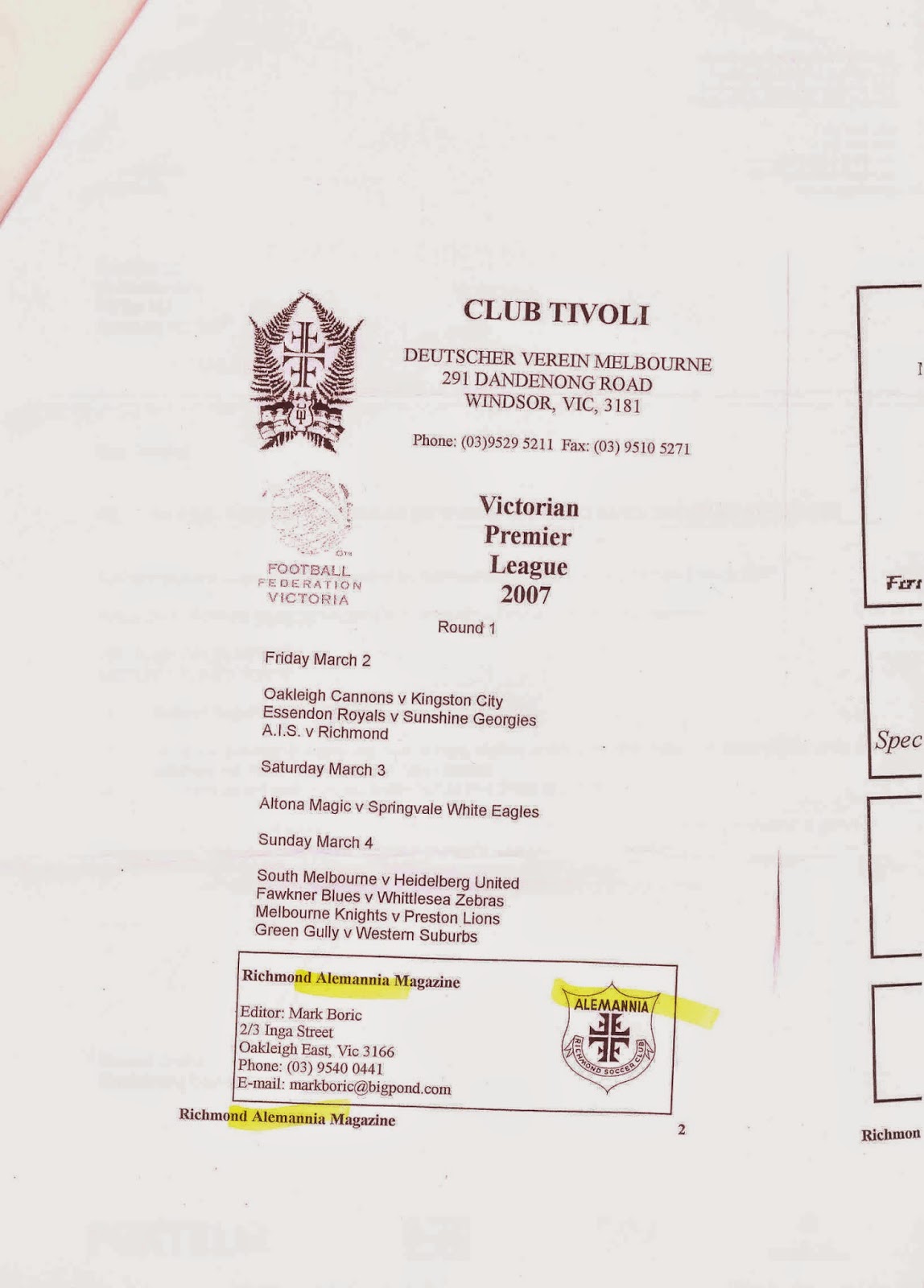
(Click on images to enlarge)
As highlighted by the FFV, the name "Alemannia" appearing alongside the club name and in the version of the club emblem was unacceptable. It poses the question as to whether the FFV discriminates against some clubs in how it enforces it's rules.
When I started Richmond Alemannia Magazine in 2002, the Alemannia name had officially been removed for many years. Even in the 1960's, the club generally appeared on league tables as just Richmond. I put the name in the title as a tribute to the tradition of the club, not in any attempt to spread German nationalism. It was as much a fanzine at times as a programme.
You may note the date on the letter is March 22nd, 2007. It arrived on the day of a home game against Essendon Royals, when 150 copies of that week's magazine had been printed and stapled. As a result of the letter, these were not allowed to be distributed. Annoying, but is any club volunteer not really wasting time that could be better spent elsewhere anyway?
So I tweeted the official FFV account to ask for an explanation. Could I be mistaken in my assumption that the rules are not being applied consistently? I'm willing to be convinced, but as yet there are no takers.
Which is why I was surprised to see this recently:
Under changes forced on other clubs by the VSF years ago, the name Maccabi appearing on this website, and the star featured in the emblem would contravene FFV rules of competition.
Here's an explanation from the FFV's Maxwell Gratton from 2007:
(Click on images to enlarge)
As highlighted by the FFV, the name "Alemannia" appearing alongside the club name and in the version of the club emblem was unacceptable. It poses the question as to whether the FFV discriminates against some clubs in how it enforces it's rules.
When I started Richmond Alemannia Magazine in 2002, the Alemannia name had officially been removed for many years. Even in the 1960's, the club generally appeared on league tables as just Richmond. I put the name in the title as a tribute to the tradition of the club, not in any attempt to spread German nationalism. It was as much a fanzine at times as a programme.
You may note the date on the letter is March 22nd, 2007. It arrived on the day of a home game against Essendon Royals, when 150 copies of that week's magazine had been printed and stapled. As a result of the letter, these were not allowed to be distributed. Annoying, but is any club volunteer not really wasting time that could be better spent elsewhere anyway?
@footballvic Any chance of an explanation? http://t.co/vC9FRzbNPn pic.twitter.com/R8U14ZxDb2
— Mark Boric (@MarkBoric) August 18, 2014
So I tweeted the official FFV account to ask for an explanation. Could I be mistaken in my assumption that the rules are not being applied consistently? I'm willing to be convinced, but as yet there are no takers.
Monday, 23 June 2014
The Dockerty Cup Finals of 1931

It is a misconception that Australia is lacking in football history, the issue is more the lack of establishing and maintaining the folklore of the game over the years. With the revival of the Dockerty Cup in recent years, it's opportune to look back and seek to find what should be celebrated as the "famous" epics of the past. One of which must surely be the triumph of the Wonthaggi Magpies in 1931.
Not competing in the Melbourne Metropolitan League, the Magpies began making an impact in Victorian football through their Dockerty Cup runs in the 1920's. A Wonthaggi team reached the Third Round in 1923, though the papers do not discern whether it was the Magpies or the local rivals Wonthaggi Caledonians/Thistle.
The Third Round was reached by the Magpies in 1927, before an appearance in the Cup Final of 1928. A replay was required to eliminate Heidelberg in the Second Round, before a convincing 3-0 defeat of Footscray in the Third Round. The Final was reached with an emphatic 6-0 win over Brighton in the Semi-Final. It was the same scoreline by which they where defeated by the Naval Depot in the showpiece at the Motordrome.
The 1928 Finalists met in the Second Round the following season, with Naval Depot getting through with a 2-1 win in a replay following a 2-2 draw in their first clash. In 1930 Albert Park prevented Wonthaggi from progressing beyond the Second Round.
Goals from P.Spooner and J.Gibson saw the Magpies defeat Hakoah 2-0 in the First Round of the 1931 competition. Hakoah were on their way to taking out the Championship of the Third Division. In the Second Round there was an easy 5-0 win to dismiss eventual Second Division Runner's-Up South Yarra.
The Third Round ended in controversy in terrible conditions in Wonthaggi. Racing to a 3-0 lead over Melbourne Thistle, heavy rain caused a delay to the start of the second half. Thistle pulled a goal back as the referee Mr.Hadlington dismissed appeals to abandon the game until he called a half to proceedings with three minutes remaining.
In the Semi-Final against Footscray Thistle, J.Spooner opening the scoring in the first minute at the Exhibition Oval before a second half equaliser brought about a replay. In the replay it was J.Spooner on the scoresheet again, his goal sending the Magpies into the Final with a 1-0 win.
On Saturday September 12, Wonthaggi Magpies took on Brunswick in the Dockerty Cup Final at the Exhibition Oval. Brunswick were seeking a League and Cup double, having been undefeated in taking out the First Division Championship. With both clubs having black and white colours, it was Wonthaggi who were allowed to wear their regular kit whilst Brunswick had to use their alternate. Neither side was able to find the back of the net, the 0-0 draw ensuring a replay the following week.
In the Replay the action moved to the Brunswick Oval. Once again, despite the use of extra-time on this occasion, the teams could not be split with another 0-0 draw recorded. This necessitated a Second Replay, held the following Saturday in Wonthaggi. A crowd of 3000 turned up to see the Magpies finally secure the Cup with a 1-0 victory. The match report and record of subsequent festivities from The Powlett Express of Friday October 2nd is featured in the picture below (click to enlarge) as it appeared in the paper:

It was an achievement which had all the hallmarks of every great underdog story. A country town, with it's roots in the harsh mining industry, prevailing over the city slickers. A team full of brothers taking on the wider world. It contains a romantic element that has gone missing from the game, which hopefully will be brought back by the return of the Dockerty Cup and initiation of the FFA Cup.


Tuesday, 10 June 2014
A Version of History

This is the blog post I've had the most difficulty in writing, and it's not just because the last time I did a book review was back at school in the late 1980's. I've struggled with how to deal with some things from a book which I largely admired and is clearly a work of great significance.
Roy Hay and Bill Murray's A History of Football in Australia: A Game of Two Halves is certainly a grand undertaking. A game with a poorly recorded history (particularly from it's own governing bodies) clouded with so many diverging political issues, it was never going to be an easy task to sum it all up in a manner that would satisfy everyone.
The chapter on the women's game towards the conclusion is a strong one. It's a lighter read than the heavy opening to the book which deals with the how the various forms of football were codified in the late nineteenth century. Once over this necessary introduction, the book soon delves into the various struggles of the game as it spread across the colonies. The hindrance of financial depressions and World Wars give way to migrant boom times and the expulsion from FIFA.
The book is tremendously well-researched, as one would expect from two fine academics. There are hundreds of notations. It touches on the "Code Wars" without becoming bogged down in them, which is no mean feat.
There are some great insights into the numerous breakaways from previous governing bodies and the early World Cup qualification campaigns. Throughout the book, there are some amazing photographs which really capture their time perfectly.
A famous quote, most often attributed to Winston Churchill, is that "History is written by the victors". With that in mind it is noteworthy that the Foreword of this book is written by Frank Lowy AC, Chairman of Football Federation Australia.
Does this mean there is a lack of balance and objectivity in sections of the book later on? One can certainly raise a few questions. In the chapter relating to the NSL it is noted that "The 1987 season began in controversy when Frank Lowy, who had been at loggerheads with the ASF about the direction the game was taking, pulled Sydney City Hakoah out of the league after the first round". It does not go on to expand on how destabilising the action was to the competition, or treat the act of spite (later it is written he "had learned and come to despise Australian soccer politics") in the same disdain later expressed at how Clive Palmer's ownership of Gold Coast United would come to an end.
Whilst much is written about the Crawford Report, no mention is made of critical elements to it yet to be implemented. Similarly whilst it is explained how the the voting structures for the State Federations were reformed to take power from top tier clubs and share it with bodies representing juniors, women's teams and refereeing bodies, little is mentioned of how the FFA no longer seems to have any elections.
The former Chairman of Soccer Australia, David Hill, though described as divisive is also portrayed rather favourably. In relation to the infamous draw with Iran which saw Australia fail to qualify for the 1998 World Cup, Terry Venables is labelled as being out-coached on several occasions. To be critical of the coach, should one be as critical of the man who appointed him? When Venables is described as erring in not bringing on Milan Ivanovic to try and hold the lead at 2-0, I can't help but think of Zoran Matic, Ivanovic's highly successful club coach at Adelaide City. The Serb Matic would have stood a better chance of being appointed Socceroos coach under any number of Croats that may have been Chairman than he did from getting the job from the famously Anglophile Hill.
Perhaps I'm making too much of these issues, but with this book likely to be the first foray into the extended history of the game in this country for many readers, it does need to be pointed out that it is just a version of history and that being definitive on such as subject is probably impossible.
Does it deserve to sit atop the pile of books about the game in Australia? It's a question, like many aspects of the sport here, that is a real political football.
Monday, 2 June 2014
Vandendriessche
Vandendriessche. It's big name in the past of Victorian football, that is largely forgotten today. It's also probably the most misspelt name in local football history. Van den Drishe, van der Drishe, vanderdrische, vandendriske and another dozen permutations when you move around the capitals and spaces a bit, they all got an airing at some stage.
Who am I talking about, you may well ask. Maurice Vandendriessche is the answer, one of the most interesting stories in the annals of Victorian football history, if only we got the full picture.
What we do know, is the Maurice Vandendriessche was born in Lille, France on the 2nd of April 1887. It says that on his French Wikipedia entry. He has a French Wikipedia entry because after winning two national championships with his club Racing Club Roubaix he gained two caps for his country in 1908.
The national championship of France, the USFSA League, had already been won on three occasions by Roubaix prior to the wins achieved in 1905-06 and 1907-08 with Vandendriessche in the side. He first represented France in a game against Switzerland in Geneva on March 8, 1908. The French recorded a 2-1 win at the Stade des Charmilles. His final appearance was less triumphant, a 0-12 defeat at London's Royal Park ground against England Amateurs later in the month. The Amateurs were captained by Tottenham Hotspur star Vivian Woodward, who scored a hat-trick but was upstaged by partner William Jordan who netted six times.
What brought him to Australia I have yet to uncover, but by 1911 he was playing in Melbourne with the St Kilda club. He was in their Dockerty Cup winning side that year, the Final seeing Williamstown defeated 4-2 at Richmond City Reserve.
St Kilda were beaten Dockerty Cup finalists in 1913, though the full-line ups of the teams that day are currently not know and he is not among the few listed in brief match reports. After 1915, the local competition was suspended for the duration of World War I, and when football returned in 1919 St Kilda did not. It was not until 1920 that the club returned to the field, and once again Vandendriessche was with them. The club finished on top of Section A of the Metropolitan League, and then defeated Section B Runner's-Up Spotswood 2-1. Vandendriessche scored St Kilda's goal in the 1-1 draw with Northumberland and Durham United for the League Championship Grand Final. In the Replay it was "N&D" who prevailed 2-0.
In 1923, St Kilda finally captured the elusive Victorian Championship. Finishing level with Footscray Thistle at the end of the season, a Championship Play-Off was used to split the clubs. A 2-2 draw was followed by a goalless Replay before St Kilda emerged victorious 2-1 in the Second Replay. It was a League and Cup double for Vandendriessche and his Saints, as they had earlier defeated Preston 1-0 in the Dockerty Cup Final in August.
The following year St Kilda were Runner's-Up in the League Championship. In 1926 they placed third, and were beaten 4-3 by Naval Depot in the Dockerty Cup Final with Vandendriessche still a mainstay of the side. He did not feature in their next Dockerty Cup Final defeat, 2-3 at at the hands of Footscray Thistle in 1929.
Towards the and of his career he once again gained representative honours, playing for Victoria in games against New South Wales, South Maitland, South Coast and a touring Chinese XI in 1923. When his career came to a close is hard to determine. In a great blog by Mark Gojszyk on shootfarken.com.au it mentions he played in Sydney, whilst almost getting Australia into the 1930 World Cup due to his friendships with French football pioneers Robert Guerin and Gabriel Hanot.
Flight listings in Lismore newspapers having him regularly flying across the country in the 1930's, by which time he was based in Sydney as a wool buyer. In the late 1940's he was a Director of Hollins Mills Australia Limited, living in the affluent Eastern suburb of Vaucluse.
His wife, Simone, had passed away in 1942. His French Wikipedia entry has no date of his passing, and a football database that may have drawn on that entry has him listed as 127 years of age, and not surprisingly, retired. He died on November 18, 1959 at the age of 72.
The modern equivalent of his career in Europe would place him above most A-League imports, if not quite as a marquee signing, though he left home at an early stage in his career. His success in business may have validated his decision to emigrate, given top level football in France did not turn professional until the 1930's. Still, it seems strange to picture someone going from French Championships and Internationals to playing in an open field at Middle Park within a couple of years.
It was certainly a most interesting career, and we may not even know half of the tale.
Who am I talking about, you may well ask. Maurice Vandendriessche is the answer, one of the most interesting stories in the annals of Victorian football history, if only we got the full picture.
What we do know, is the Maurice Vandendriessche was born in Lille, France on the 2nd of April 1887. It says that on his French Wikipedia entry. He has a French Wikipedia entry because after winning two national championships with his club Racing Club Roubaix he gained two caps for his country in 1908.
The national championship of France, the USFSA League, had already been won on three occasions by Roubaix prior to the wins achieved in 1905-06 and 1907-08 with Vandendriessche in the side. He first represented France in a game against Switzerland in Geneva on March 8, 1908. The French recorded a 2-1 win at the Stade des Charmilles. His final appearance was less triumphant, a 0-12 defeat at London's Royal Park ground against England Amateurs later in the month. The Amateurs were captained by Tottenham Hotspur star Vivian Woodward, who scored a hat-trick but was upstaged by partner William Jordan who netted six times.
What brought him to Australia I have yet to uncover, but by 1911 he was playing in Melbourne with the St Kilda club. He was in their Dockerty Cup winning side that year, the Final seeing Williamstown defeated 4-2 at Richmond City Reserve.
St Kilda were beaten Dockerty Cup finalists in 1913, though the full-line ups of the teams that day are currently not know and he is not among the few listed in brief match reports. After 1915, the local competition was suspended for the duration of World War I, and when football returned in 1919 St Kilda did not. It was not until 1920 that the club returned to the field, and once again Vandendriessche was with them. The club finished on top of Section A of the Metropolitan League, and then defeated Section B Runner's-Up Spotswood 2-1. Vandendriessche scored St Kilda's goal in the 1-1 draw with Northumberland and Durham United for the League Championship Grand Final. In the Replay it was "N&D" who prevailed 2-0.
In 1923, St Kilda finally captured the elusive Victorian Championship. Finishing level with Footscray Thistle at the end of the season, a Championship Play-Off was used to split the clubs. A 2-2 draw was followed by a goalless Replay before St Kilda emerged victorious 2-1 in the Second Replay. It was a League and Cup double for Vandendriessche and his Saints, as they had earlier defeated Preston 1-0 in the Dockerty Cup Final in August.
The following year St Kilda were Runner's-Up in the League Championship. In 1926 they placed third, and were beaten 4-3 by Naval Depot in the Dockerty Cup Final with Vandendriessche still a mainstay of the side. He did not feature in their next Dockerty Cup Final defeat, 2-3 at at the hands of Footscray Thistle in 1929.
Towards the and of his career he once again gained representative honours, playing for Victoria in games against New South Wales, South Maitland, South Coast and a touring Chinese XI in 1923. When his career came to a close is hard to determine. In a great blog by Mark Gojszyk on shootfarken.com.au it mentions he played in Sydney, whilst almost getting Australia into the 1930 World Cup due to his friendships with French football pioneers Robert Guerin and Gabriel Hanot.
Flight listings in Lismore newspapers having him regularly flying across the country in the 1930's, by which time he was based in Sydney as a wool buyer. In the late 1940's he was a Director of Hollins Mills Australia Limited, living in the affluent Eastern suburb of Vaucluse.
His wife, Simone, had passed away in 1942. His French Wikipedia entry has no date of his passing, and a football database that may have drawn on that entry has him listed as 127 years of age, and not surprisingly, retired. He died on November 18, 1959 at the age of 72.
The modern equivalent of his career in Europe would place him above most A-League imports, if not quite as a marquee signing, though he left home at an early stage in his career. His success in business may have validated his decision to emigrate, given top level football in France did not turn professional until the 1930's. Still, it seems strange to picture someone going from French Championships and Internationals to playing in an open field at Middle Park within a couple of years.
It was certainly a most interesting career, and we may not even know half of the tale.
Subscribe to:
Posts (Atom)