The Richmond Alemannia History website is finally up and running. Most of the results and tables, as many of the scorers and line-ups available. All the match progammes and videos I could find. All in one place, in an easy to find order - season by season and chronological.
Still more do find and do, it is constantly being worked on. Share with someone that may enjoy some memories of what was once a great club.
Click on the image below or the links on the right.
So with the the A3 scanner having packed it in, and the A4 scanner not being much use scanning A3 newspapers and being temperamental itself as well, my focus has turned to tidying up a very messy hard drive.
Over the years I've started records for both Moorabbin City and Richmond Alemannia, but it was very piecemeal. Seasons here and there, some detailed, some with next to nothing.The formats of the records varied from season to season, and between the clubs. Most team line-up files included just a surname, some had a first initial. So getting these records in order is long overdue.
When it comes to match records, the starting point is obviously the date of the game, score and goalscorers, with a venue, referee name and team line-ups all preferable.
Sadly, over the years, goalscorer information for anything below the top tier in Victorian football has been abysmal. Official top goalscorer awards for leagues only regularly commenced in the early 1980's. Even the Soccer News, the "Official Organ of the V.A.S.AF.A." did not publish goalscorers alongside it's results from the 1940's through the 1970's.
Venues can be sourced from VASFA/VSF Yearbooks, in most cases. There will be the odd club that was still searching for a home at the time of publication. Sometimes these can be picked up in a news item in Soccer News, sometimes they can't.
Referee's names were often published in the mainstream media alongside fixtures for that week's games at times from the 1920's to the 1930's. Soccer News only did this with much frequency in the late 1960's.
Team-line ups were a feature of early newspaper match reports, at least for the top levels, that began to wane after World War II. With the advent of Soccer News, you could get predicted line-ups for that weeks games, but match reports of the previous weeks games would not have any. Sadly most clubs did not take up the offer to have their teams listed in Soccer News by sending them through, despite constant appeals and threats of fines and leading to this part of the magazine eventually being dropped.
The files above are what I've gathered for both clubs up to the end of 1964 so far. It gives an indication of how much of this information is missing. Later seasons will be easier and be more comprehensive when I work up to them, my greatest task there being adding first names to the existing line-ups I have.
In the era covered above, we find that grounds were still being referred to as the street or road they were on before a park had been given a formal name (see Patterson Road, Bentleigh being the latter Victory Park and Olive Street, Hampton being Sillitoe Reserve). Richmond have gone from the Migrant Hostel in Maribyrnong to Survey Park and Burnley Oval to Olympic Village and Schintler Reserve for their Victorian State League home games (with Olympic Park appearances as well).
We can also see how much use the parks of Middle, Yarra, Princes and Royal got.
When they are both finished, maybe the State Library will be open and accessible once again to see if any more information can be added.
I've tended to stay away from the current issues involving Richmond SC and it's takeover by Fitzroy City for a number of reasons, most of which I previously detailed in this piece. Also mostly because I'm not in a position to get back involved in club football, so as such can only offer moral support to those willing to keep the club going.
I do believe it needs to be noted that the facilities at Kevin Bartlett Reserve, probably a million dollar asset for he council now, were built largely by the members of Richmond Alemannia SC in the 1980's. The initial set-up saw $60,00 provided by the State Government (not the Council) with the club providing the rest, as well as most of the labour.
Since then many of the improvements and upgrades (upstairs media/VIP area and lighting chiefly) were again funded mostly by the club.
The Council may not care for the history of the club, and may find this takeover a more convenient solution to to the issue of Fitzroy City needing better facilities, but it ought to make sure democratic processes have been followed. They should also be aware that over the course of Victorian football history clubs have only ever taken over others for two reasons - to gain a higher league place or to gain a better facility.
In the cases of struggling clubs being taken over by others, many have amounted to the "selling" of a ground or league position. The council, and Football Victoria, owe it to those who would like to see the club carry on independently to make sure that is not what is happening here.
Football Victoria, or Football Federation Victoria as it was then, has already been caught on the wrong side of history in previous disputes, most notably the 2009 Whittlesea Zebras debacle. Now we will once again get to see if they stand for rank and file grassroots members, or side with the "money men" as usual.
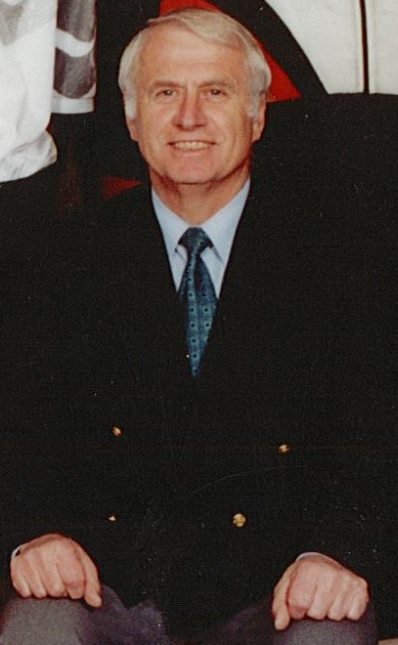
Manfred Kuhn was born in Berlin in August 1939. After the Second World War his family had moved to a farm in the old German Democratic Republic (East Germany) before again moving, this time to Cologne (Koln - West Germany) before the borders with the Federal Republic of Germany were fortified in 1961.
In 1966, Manfred emigrated to Australia. He was picked up from the Bonegilla Migrant Reception Centre by a delegation from the Alemannia Richmond Soccer Club, keen to improve their playing strength after struggling since being relegated from the Victorian State League in 1963.
The club would become a central part of his new life in Australia. He would become captain by the end of the decade, and would continue to star in the first team (winning Best and Fairest as well as leading goalscorer honours) until the late 1970's. He later served as both a Secretary and Treasurer of the club well into this century, including the period when it returned to the top flight of the Victorian Premier League. Whilst becoming an administrator at Richmond SC, he did not cease playing, joining Juventus Old Boys in the Veterans competition where he continued turning out until he was in his mid-60's.
A vibrant character who loved to sing (possessing a booming, operatic voice) he was a fixture at the Saturday night dances at the German Tivoli Club. It was there he met his future wife, Anna. Having asked her to dance, he began serenading on the dancefloor. She looked around and was surprised to see no one else was batting an eyelid at his behaviour, and the rest, as they say, is history.
Manfred and Anna would go on to have two daughters, Natasha and Yolanda. He worked in insurance, and was a pillar of the local German community on more than just the soccer side. His is a great Australian migrant story, in which the sporting and ethnic social club were pivotal.
Sadly his latter years saw him suffer from dementia, leading him to stop attending games at Kevin Bartlett Reserve and finally taking his life.
He was a hard working, family man. He was fun to be around. He deserves to be long remembered.
Some of the following could have been included in the Why I've Arrived Where I'm At post from March, and some from Elitist But Not Elite as well but I was trying to put a limit on my rambling at the time.
On Friday the Richmond Soccer Club put the following message on their Facebook page:
I would be lying if I said I was surprised, as this has been a long time coming, six years in fact.
A poor start to the 2011 season by the Under 21's precipitated the end of Helmut Katizki's presidency at Richmond. Donald MacLaren had taken over the side after assisting Jim Maclean, and an element of the committee from the juniors side were not satisfied with performances. The pressure to make a change continued to build, and eventually a newcomer to the committee, Jean-Marc Imbert, was made caretaker coach for the remainder of the season.
The following year it was senior coach Michael Chatzitrifonos who was under the pump. Early season losses prompted agitation from some of the committee. He had cut Didier Imbert from the senior squad during pre-season, before politicking forced a reconsideration. The tensions reached a head in early June following a 0-2 loss at home to Hume City when Chatzitrifonos quit his post after being confronted post-game.
Kalitzki managed to get Chatzitrifonos back on board the following day but the damage had been done. Captain Michael Ferrante, struggling with a back injury that would not see him play regularly for another year after surgery, left the club dismayed at the politics that had crept in, clearly able to see the writing on the wall. The team's results would improve, eventually finishing just three points off a finals berth, despite the turmoil off the park.
The committee was now dis-functional and having failed to oust Chatzitrifonos they now set their sights on Kalitzki. Their meetings required security intervention. Prior to the final game of the season, Kalitzki met with the players to announce he had stood down as president. Though he always honoured promises over player wages, he told them to see the new committee about payments for the final game but hoped that they would still turn out and play for each other and their coach. Following a spirited 1-1 draw away at the league champions Dandenong Thunder, Chatzitrifonos finished his tenure at the club after five years.
The new committee appointed Imbert as first team coach for the following season. The core of the playing squad moved on, though Davey van 't Schip was happy to stay and play with his mates who had remained. A bust-up with Imbert in pre-season though saw him follow Ferrante and Tom Milardovic to Pascoe Vale where he remains to this day, one of the best players in the NPLV. After four straight defeats at the start of the 2013 season, culminating in an embarrassing 2-7 defeat at home to Northcote City, Imbert was dismissed. By the end of the year the club was relegated, and those that had ousted Kalitzki had all jumped off the ship they had sunk.
There'd be something darkly fitting about Davey winning the Gold Medal on the day Richmond announced it was broke.
The club rallied under a new committee and in 2015 with the backing of sponsorship from Concave won the then NPL1 to secure promotion back into the top tier. Instantly relegated, it was a second successive relegation this season that has brought the club to the brink on which it now sits.
So in reading the commentary to the club's EGM announcement it was interesting to see how some apportion the blame for the predicament.
There were some fingers pointed at the FFV and also the NPL set-up as a whole. What is clear is that relegation from the NPL will have a more devastating effect on clubs than relegation from the VPL did. What can a club do if the bulk of their junior players may be looking to stay in the NPL system by moving to other clubs? When committee people may be pondering such a move for their own children, it's easy to see how a crippling exodus may occur. Battling to meet the costly NPL requirements no doubt causes a lot of burn-out as well.
Does the NPL set up, particularly in NPL2 do clubs any favours? I recall in the heyday of Friday nights at Kevin Bartlett Reserve, the bar and canteen would make twice as much as it would with the same crowd on a Saturday afternoon. So what does hosting a single busload of players and officials from Goulburn Valley or Murray United on a Saturday offer? A 28 game season means six more week's worth of wages need to be found than previously. Not that every club relegated from the NPLV will find themselves in Richmond's predicament, but there would be a few others skating closer to the edge than they'd like to admit.
Of course the lack of stability since the departure of Kalitzki leads some to point out the perils of relying on a single benefactor. From what I've seen though, few clubs would cover their costs on gate takings alone. Surely a benefactor or sponsorship is preferable to using junior membership fees? The old chestnut of clubs being at the mercy of the whims of such benefactors also rises, as if they just like to withdraw their support for a laugh. Most benefactors would prefer clubs become less reliant on them, but that can take years to achieve. Since Kalitzki the club was aided by various sponsors, none of whom have been long term.
I think the situation Richmond has found itself in illustrates how committees with junior parents dominated by self-interest will destroy more clubs than these supposedly flip-flopping benefactors do. And for that the FFV has to shoulder some of the blame. A decade ago now the FFV forced clubs to alter their constitutions to allow the parents of junior players a vote at club's elections, which probably assisted the ousting of Kalitzki at a club with a small member base like Richmond.
Of course the two A-League clubs with teams in the NPLV do not have to comply with these rules. These privately owned clubs are allowed to operate without the ability of a group of Under 14's parents upset at being confined to the back pitch all season to wrest control from Sheikh Mansour. Melbourne Victory's chairman Anthony Di Pietro is safe in the knowledge he doesn't need to placate the parents of the kids sitting on the bench in their NPL2 West U20's team to keep his role. Funnily enough the person I used to argue with on Twitter about the unfairness of this is currently on the run in Romania from Australian taxation authorities so we are not able to resume that debate.
Though the FFV saw fit to meddle with constitutions, there's no protections put in place that could prevent the scenario that has occurred at Richmond. When those on the committee failed to get their way in sacking the coach and demanded money they had put into the club back, the president had the option of paying them, or standing down and letting them have their way once the situation had become untenable. When the following committee failed to achieve what they wanted and left, they were free to be able to do so. They did not have to be held to account, it was left to others to pick up the pieces if they wanted the club to carry on, and saddled with debt they managed to move it on a little further to the crossroads it now finds itself.
It also needs to be noted that none of the changes to the competition made with the introduction of the NPL where made with the clubs, and their best interests, in mind. As with much of Australian football decisions are made on a "top down" basis. The authorities give little consideration to those running clubs. If clubs fall over they know another one will take it's place.
Having put in 30 hours a week at the club for over ten years, it would be sad to see it go under. Cannot say, though, that I'd be sad enough about it to go through all that again to save it. Which in itself is the saddest part.
It was not until I was seventeen years of age that I played my first ever competitive game of football. The chief reason for this would probably be my father developing lung cancer in the early 1980's. At the age I may have been introduced to junior sport, there were other things going on. I spent equal amounts of time kicking a footy or a soccer ball around in the backyard, and took part in lunchtime soccer games at primary school.
Competitive sport at East Oakleigh Primary School began in Grade 6, and I tried out for the soccer team but was placed in the "B" squad, not quite near the level of the kids that had undergone coaching and were already picking up Soccer Action Hat Trick Certificates. The "B" team ended up not going ahead because there were not enough numbers to field the Aussie Rules team unless the Soccer B squad was conscripted.
This fork in the road actually led me to play weekend club footy for Oakleigh Youth Club six years before I would first play organised soccer. I must have been okay enough at the school footy for someone to suggest I go down to the club, and it fitted it well enough with my now widowed mother's work schedule for it to happen. While I was a prominent enough member of the school team, we weren't much chop. At Oakleigh Youth I was very much a fringe player, but we were sensational, losing only one game all season on the way to capturing the Grand Final.
When moving up to secondary school, at Salesian College Chadstone, I didn't try out for either footy or soccer teams, opting for table tennis which I was handy enough at. The senior soccer team there had a State Championship pedigree, and I knew I hadn't done anything to bridge the gap between myself and the kids already excelling at junior clubs. I assumed the footy team would be strong as well, and thought I would be on the periphery there as I had been at Oakleigh Youth Under 12's.
I'd adopted Tottenham Hotspur as my club of choice, on the back of their F.A. Cup Final success earlier in the decade. I followed them through the combination of old Shoot! magazines and the results in Monday's newspaper. Then came Saturday nights staying up to listen to the marvelous sports coverage on the BBC World Service.
Locally I followed Melbourne Croatia from nearly as afar as Spurs. I had vague memories of attending a game in the late 1970's at Olympic Park No.2, where I asked if we could come back when the greyhounds were on. Reading newspapers and watching the SBS/ABC television coverage of the NSL was the limit of my involvement.
So when I'd started Year 12 some family friends I had backyard kickabouts with (they were a little younger) suggested I should go down to Bailey Reserve (where they played at East Bentleigh juniors) as they heard there was a shortage of players in a senior team there. Their family friend, Justin Scrobogna, was a brilliant junior soon to break in to the Moorabbin City senior team. He may have heard of or been one of the reserves players asked to back up on Sunday for the Thirds and told them, whatever it was they told me so on a Tuesday night in 1990 I turned up at Bailey Reserve. I trained with the reserves that night, then the Thirds on Thursday when they showed up. On the Sunday I started in central midfield against Monbulk and we won 2-0.
Before long I was playing two games a week, as I also joined the Salesian College Senior B team. After contributing a few things for the club magazine, Moorabbin Matchday, I was soon asked to edit it. Which of course, meant writing it all. Did it on an old fashioned typewriter (google it if you have to). The following year I began attending more senior games, and after that I was club linesman every week for the reserves. I soon became familiar with putting nets up, and taking them down. Got covered in lime loading and using old school line marking machines. There was a bit of canteen work, and a few relief stints manning the entrance gate. Club functions saw more bartending work.
The club began to climb the leagues, eventually rising from State League Division Three all the way to the Victorian Premier League. There was a year where we played out of Gaelic Park in Keysborough, where heavy wooden goalposts had to be lifted in and out of place every matchday. That was the result Bailey Reserve not being up to higher league standard, and the new ground at Kingston Heath not yet ready. The first years at Kingston Heath saw times where I'd mark and put nets on all four pitches in a single morning. The clubrooms and dressing rooms were portable buildings, before the current structures at the site were erected. Indeed work on the permanent buildings had barely commenced when Moorabbin City folded at the end of 1998.
The factors for that were numerous and I won't go in to them now. The end result was a way of life had come to an end. I didn't realise how loyal I had become until it ended. I would continue to play with the Moorabbin Thirds, as we became Moorabbin Old Boys playing out of Gardiner's Creek Reserve. More than a few Moorabbin players moved there as well, joining the then Old Scotch Waverley (previously Waverley City, now Eastern Lions). I went to a few games, but did not want any further involvement. I was a Moorabbin person, and that's all I wanted to be. I'd expected to be Moorabbin City for life, and didn't want to be anything else.
Now football solely centred around a Thursday night kickaround for training and a game on Sunday with the Thirds. I started going to more NSL games, mainly to Somers Street to watch the now Melbourne Knights, but also to Optus Oval and Olympic Park for Carlton SC matches as well as Bob Jane Stadium to see South Melbourne.
Then in early 2001 I got a call from from former Moorabbin president and secretary Sam Laverty. He'd been asked for assistance in assembling a new squad by Helmut Kalitizki, who had taken over as president of Richmond following their relegation to State League Division Two. They'd just played a practise game and the players weren't particularly well looked after on a scorching summer's day and I was clearly the go to man when water bottles needed filling.
I would say the main reason I responded to the call was a personal loyalty to Sam. He had minor involvement at Old Scotch Waverley after Moorabbin City folded, but never pushed me to follow. Now he was actually asking me to help out, I couldn't say no.
For the first season I only attended match days, being team manager for the first team. The next year that would evolve into training nights. Establishing and "editing" the Richmond Alemannia Magazine followed. Managing the first team became managing the reserves as well. Kits were washed, week in, week out. You never forget how to put a net up properly. Kevin Bartlett Reserve being alongside the Monash Freeway led to some challenging ball retrieval work.
Eventually Richmond would also start the climb back up the leagues, also rising all the way to the Victorian Premier League. This would in part lead to the inner conflict which now sees me follow the game as a distant observer, rather than a passionate participant. Even after a few years, I still considered myself a Moorabbin person. Moorabbin Old Boys played one season at Richmond before getting too old (I was ten years younger than most). The rise of Richmond meant an ever increasing workload, and it came to the point where for the Old Boys to continue I'd have play a greater part than simply turning up to play and that was not a viable option so playing retirement had arrived.
There was the rise of the internet. Participating on local forums, as someone from a club lacking a huge supporter base , I sort of became the face/spokesman of the club to many. Which was odd, as deep down I still felt I was more Moorabin than Richmond. The rise of the internet, naturally, also soon saw me running a club website.
Success brings great times, so soon that feeling began to change. As time passed it was only natural I would become more comfortable being a "Richmond person". The end of the NSL saw Melbourne Knights join the VPL. A year later, Richmond were promoted to the VPL. When we would come to clash, my loyalty went one way and it was the way of the team in white. Now I was truly Richmond.
At the same time, the A-League had come into existence. Melbourne had a new team, Melbourne Victory. I went to a few games when I wasn't busy with Richmond, and naturally wanted them to beat the interstate scum. There was no way I could muster any real passion for them though, and snobbishly I'd question the motives of many who overtly had that passion. I mean, this was not a club they had grown up following, or had began following in a family tradition. They hadn't played for them as kids, it all seemed a bit cheap.
Matchdays would involve arriving at the club by 4pm on a Friday afternoon to put the nets up and flags out and put ice in the freezer. I had a huge set of keys, some for the gates that were used to turn an open park into an enclosed venue. There'd be checking that the away rooms were tidy. Then setting up the home room by bringing in the kit, pumping up the balls for the warm up. Drinks (2 trays of water bottles, one for each team, two five litre cordial mixes - one orange, one apple raspberry - and a twenty litre Powerade/Gatorade mix) would be prepared, as well as a supply of lollies laid out to keep the players buzzing. Fill in some team sheets, hand out some shirts. Give the referees the match balls. Copy the team sheets for any media in attendance. Get the players to put their valuables in a case and lock it away for safekeeping. Make sure there were whiteboard markers and magnets at the coaches disposal. Find some new socks for the players that needed them every second week. Pour out 30 cups (10 of each flavour) just before half-time time. Take notes for Goal! Weekly and club website match reports. Watching the first half of the seniors was problematic because I had to clean up after the reserves/Under 21's to get ready for half-time (we only had one room to share). As a result the second half of the senior game was usually the highlight of the week. Then it was deal with the match officials after the game faxing results in and what not. Load the washing into the car, put the drinks containers back in the coolroom. Clean out the home and away team dressing rooms forn the juniors on the weekend, take down the nets and bring in the flags. Then have a chat with whoever was left in the clubrooms after 11pm.
At the end of 2012, after eleven years at Richmond, I left the club. It was a case of personal loyalty exceeding loyalty to an institution. Helmut had been forced into a situation which saw him step down as president, and I made it clear to people remaining on the committee they would be wasting their time asking me to continue in my roles. At that stage, I was as relieved to have a break as I was sad. A small club overachieving doesn't happen easily.
Before the start of the following season came a point when I would be more than not involved in the club, but where the term estranged would be more apt. This began to take place when one of the committeemen responsible for ousting Helmut appointed himself senior coach. It became official when the club signed Josh Groenewald.
The night Semir Sivic had his leg broken is without doubt my worst moment in football. Worse than losing any game, even a Grand Final. Worse than Moorabbin City folding, and that had randomly brought me to tears on one occasion. I had been a part of a dressing room, where if for some inexplicable reason Josh had been brought into as a new signing, every person to a man would have walked out. That he had been signed by the same people who brought Semir's brother Enes back to the club marked that the club was no longer the same. Not knowing the history there was something I could not abide. There was also the sense that in signing players who refused to talk to each the new regime had no idea what it was doing and everything the club had achieved in recent years was about to go to waste.
In one way the estrangement was not permanent, but in another it was. The week after the coach was sacked after four straight defeats culminating in a 2-7 loss at home I received a phone call from the new president, Wolfgang Smoger. My replacement as team manager had to return overseas for a month, there was Dockerty Cup game that night, and I was asked to fill-in. I said I would, then called Helmut to let him know that I was going back, to see if he'd object to what I'd agreed to. He didn't. Grant Brebner was then appointed coach, and I stayed on until the end of the season assisting the team manager upon his return from overseas. It was not the same though, it never could be, a bond had been broken and at the end of the year I declined requests to continue.
Long before the club's eventual relegation that year, the whole situation would just make me sad. I'd see Josh in the changing room and feel bad for having hated him. Did I still hate him? Not really. No. Did I approve of him being at the club? No, but he was. We wouldn't have spoken much. I assumed that he'd known what I thought of what had happened, but maybe he didn't. Either way, it was not an area to go to.
I now go to games and hope the team does well, but the life or death nature is no more. Where there was certainty, now there is conflict. I still feel "Richmond", but no longer am. I feel I would be cheating to label myself a Knights fan when I compare myself to genuine die-hards. Part of me now feels like a neutral at games even when I'm there to support a particular team. This may also stem from going to watch the former Richmond boys at their new clubs. There's also plenty of people I respect at other clubs, which makes it hard to hate. More than anything though, it's because when you've been in the inner sanctum so deeply, and then step out, you end up an outsider just looking in.
It's for that reason that this blog is more about the past than the present and future than intended when I started it. I just don't enjoy going to games as much as I used to, and still have concerns about the direction the game is heading. Since I first started to do some research as Moorabbin began to plan to prepare for it's 50th anniversary, compiling a history of the local game has been a project on the backburner, now you know why it's at the forefront of my endeavours.
Since belatedly discovering that Microsoft Paint and Microsoft Photo are a little more advanced on Windows 10 than they were on Microsoft XP over ten years ago, I thought I'd go through some documents and cut, paste, straighten and crop some old photos.
A shot from the famous 1962 VSL game between South Melbourne Hellas and George Cross at Olympic Park. The stands are a mass of humanity, as over 22,000 people crowded the venue.
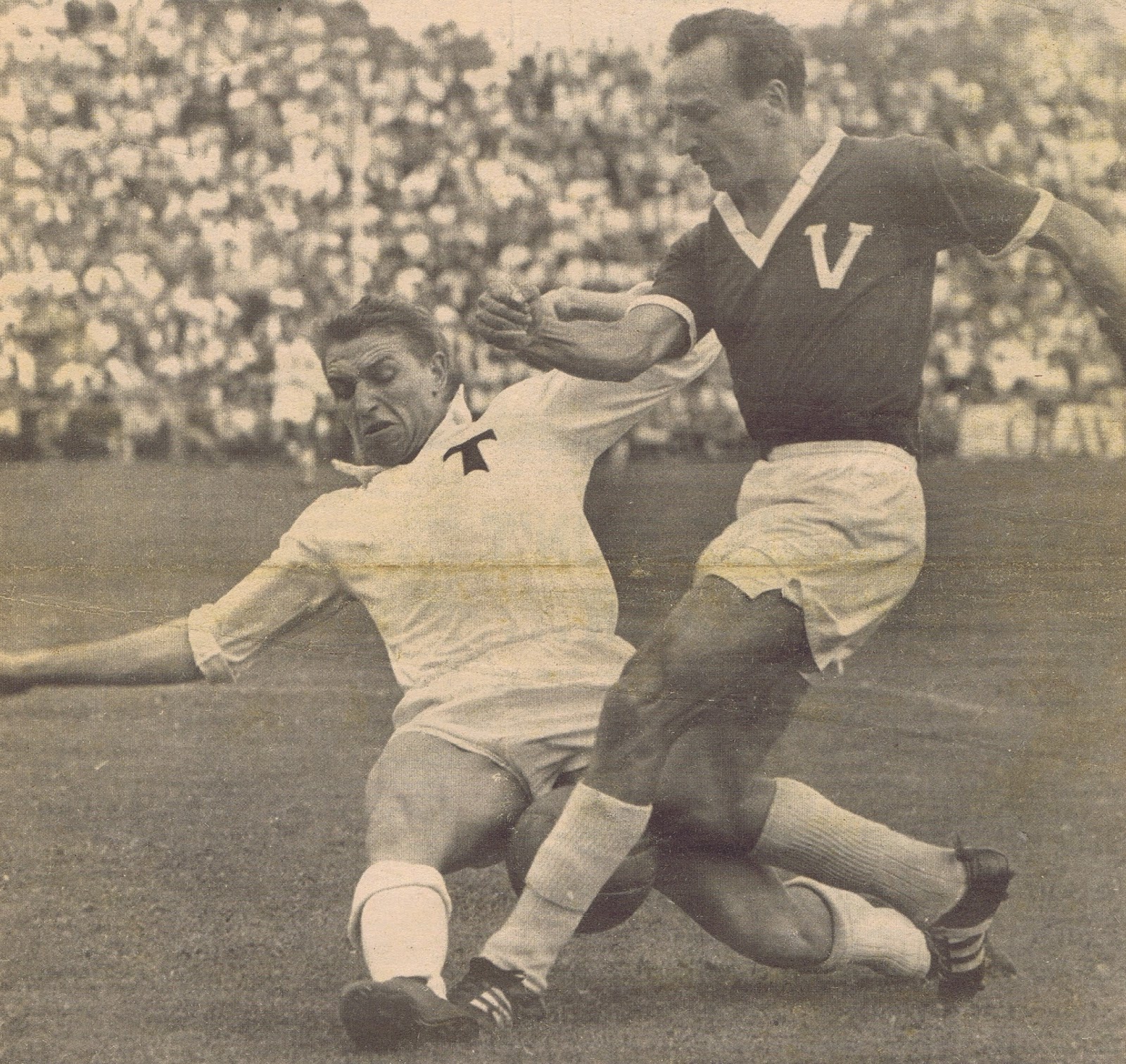
Another big crowd at Olympic Park watches Torpedo Moscow's Brednev go to ground as he tackles Victorian star Mike Jurecki in their 1965 clash.
On to another lost ground with this great wide shot of Middle Park in 1968.
Only just a star at the time, later to be a South Melbourne Hellas legend, Jimmy Pyrgolios in 1968.
A great Victorian state team from 1967. Willy Schroif, who played in a World Cup Final. Johnny Sanchez, an early Bill Fleming Medal winner. Jimmy Armstrong, goalscoring legend of Hakoah and South Melbourne Hellas who still helps out at Lakeside. Hammy McMeechan, who remained active in the game until his passing. Tommy Stankovic and Frank Micic, who were probably the two greatest ever J.U.S.T. players.
Nino Borsari, Olympic Gold Medalist, Patron of Victorian Football. A great gentleman of Carlton.
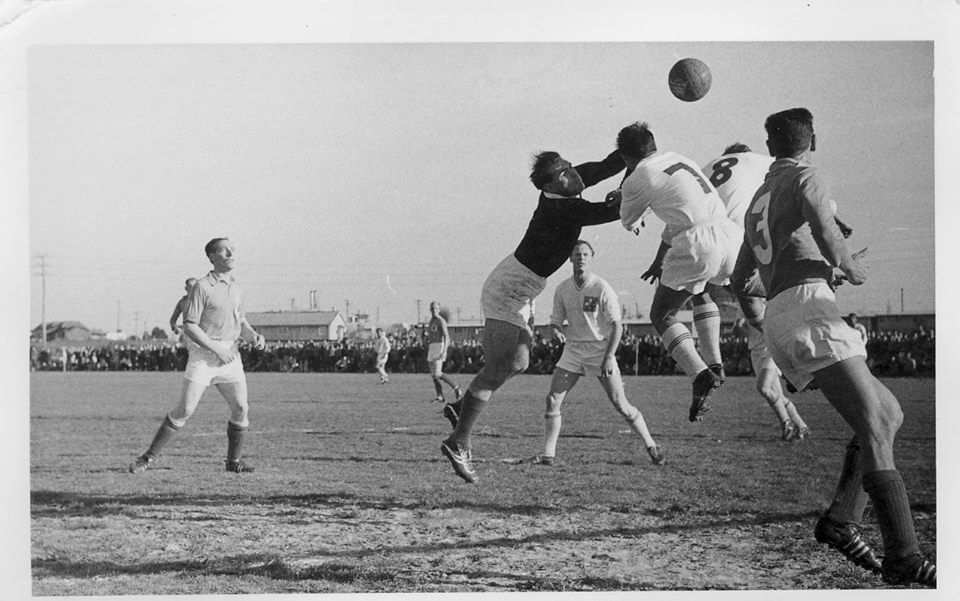
The ground remains, the grandstand does not. Action from Jubilee Park in 1963 as Layt of Ringwood Wilhelmina lead's Richmond Alemannia's Zammit to the ball in their VSL game.
Ringwood City 1982. Brooksy of the Music Men in the front row. Coached by Sjel de Bruyckere. Sjel was often referred to as Mike, but since the NCIP scandal I have amended all my records to include his proper name.
Richmond Alemannia player hi-jinx on the front page of Soccer News as Rudi van Altena holds back Peter Erasmus so Billy Copeland can cut his beard.
Prahran City team shot from 1969. Got the nod ahead of other team photographs found in Soccer News from that era simply because the goalkeeper is sporting a flat cap. You can't beat goalkeepers that wear flat caps.
In another case of it's hard to believe now, humble MacDonald Reserve (now known as Burke Road South Reserve, previously also known as Hawthorn South Reserve) hosted Victorian State League football as the home of Wilhelmina in the late 1950's and early 1960's.
The ground currently has no car park of it's own. There is very limited street parking on Sinclair Avenue. There have been many changes alongside the the ground since that time, which can be appreciated when we look at the Melways map from that era.
To the north, the drive in theatre became the Coles complex at Tooronga Village. The brickworks are long gone, and to the south Carroll Crescent disappeared to make way for the South Eastern Freeway. The majority of football patrons attending games would have come via trams down Burke Road or from the Gardiner train station.
The facilities are sparse. When I visited, cricketers using the nets at the south eastern end parked on the street and had no rooms to change in. The only structures on the site are a storage shed at the north eastern end, and another building further up the hill from it, which may have been the changing rooms when the ground was a VSL venue.
The quaint building sits near the storage shed, but it may also be that the current storage shed was even the changing room back then.
The view across the pitch looking from the east to the west. Behind the trees lies Gardiner's Creek and the Monash Freeway.
With it's lack of amenities, it's the hill on the Sinclair Avenue side that would have been a major attraction to the ground for Wilhelmina as a home. It would have been able to give the crowds they were drawing a decent view, a major problem in the days when standing behind the rope on a flat open park was the prime spectator location.
Another view of the storage shed, changing rooms behind it, and the eastern side of the ground.
Looking south, towards the cricket nets. Behind that would have been the bowling clubs, and further beyond would be Gardiner railway station.
Looking east from the south western corner shows how steep the hill is, and the limited amount of street parking around the ground.
The view when looking north to where the drive in cinema would have been, which is now the corporate headquarters of the Coles supermarket chain.
The ground is in excellent condition, as you would expect in the leafy inner eastern suburbs of Melbourne. Wilhelmina began playing there when promoted to the First Division in 1957, having previously used Survey Park in Burnley (later a home of Richmond Alemannia). The club also used Olympic and Middle Parks for home games in that era, but MacDonald Reserve was chiefly their home venue until they established Jubilee Park in Ringwood in 1962. The club then changed it's name to Ringwood City Wilhelmina, eventually becoming just Ringwood City.
Could the following picture be of the game between Wilhelmina and George Cross which drew 1400 spectators to MacDonald Reserve on Saturday August 12 in 1961?
If it is, it would had to have been taken from the north eastern side. It is possible that the buildings in the background could be a part of the brickworks. It's worth further investigation, as it would be great to have an image of top flight football from this long forgotten venue.
(Click on images to enlarge) Edited to add photo from Wilhelmina v Juventus Dockerty Cup tie in 1956
Today I present some artefacts relating to a long gone day of internet banter getting a little too serious.
Before I start I need to provide a little background to what stemmed from the battles on the old SBS The World Game Forum and my position relating to the A-League, which was the cause of my gaining a stalker.
Now though I'm probably associated with people who hate the A-League, that is certainly not my position. I've been to games, I watch them on television regularly. For various reasons, I'm not a supporter of either of the Melbourne clubs. One being I was busy enough at Richmond SC when the A-League came about, and that was MY team. Someone once said to me they are members at Victory, but go there mainly for their kids. It's their kids who will grow up diehards, but they themselves are less "invested". I guess embracing a club too closely once you've reached a certain age and affiliations with other clubs doesn't suit everyone. So while I was happy to go to games and wanted Victory to do well, I was able to be dispassionate about the whole situation.
One thing that contributed to this was that I did not want to associate those that gladly denigrated the players, supporters and clubs from previous eras. Sadly, on The World Game Forum, there was no middle ground. You supported the "New Dawn" of New Football or were "Bitter" about the demise of Old Soccer.
That was not the main reason for my sympathies towards Victory beginning to dissipate around 2007-08 however. The major factor there were the actions of Victory fans in the VPL at that time, in particular the Richmond v South Melbourne game of March 9, 2007.
Now to get to the first artefact, let's move on to 2010. mdm was a username on The World Game Forum of a Victory fan with a strong grudge against "bitters" and the presence of a New Zealand team in the A-League. I generally tried to avoid too much of the Bitters/New Dawn nonsense, but took him to task when he tried to link a murder case to the NSL. The father of Santo Caruso, proprietor of Melbourne Sports Books, had murdered his wife and been jailed. When someone in a thread had recalled Santo attending NSL games, mdm mistakenly claimed that Santo had committed the murder and tried to draw a link between that and his support of the NSL. Yes, this how unhinged he was.
Many may recall on the eve of the World Cup that year Socceroo goalkeeper Brad Jones withdraw from the squad when his son was diagnosed with leukemia. On another forum I got some inside gossip that this had taken place just before I went to sleep one night, with the news breaking a few hours later at around 2-3 am. When I got on the forum the following night, I saw mdm posting in a thread about the topic at around 5 am that there were not many bitters offering sympathy. His inference disgusted me, and I showed this in no uncertain terms.
The result was that mdm felt he could agitate me by constantly using my real name or initials in his posts. My username was 11.Boo, based on my widely known nickname (widely known as in most people who know me through football use it, many not even knowing my real name). I was not that bothered about it, as I was not trying to keep it a secret. It had been done by others before anyway. The first artefact sprang from someone else supplying me with mdm's real name, and myself using his initials in replies in response.
The above sign was cable-tied to the fence at Kevin Bartlett Reserve on Wednesday July 28, 2010. I'd taken the week off work for a busy football week. That night the seniors played a friendly against Melbourne Heart at AAMI Park, at the same time as the Under 18's played as the Under 21's against the N.T.C. before the Under 21's played as the seniors against the N.T.C. at Kevin Bartlett Reserve. I discovered the sign as I went to put up the nets, mark the pitch, set-up the dressing room and drop off the kits at KB before heading to AAMI to look after the first team.
Marking the pitch I put a lot of thought into who was behind the sign, but it wasn't until I got to AAMI Park that I thought it could be mdm. When I got home I sent him a direct message via the forum asking if he'd been been to Burnley recently and he responded he hadn't (using the term "mate", which was odd) and then never posted there under that name again.
The next artefact came shortly after I shared the photo on a few forums.
It is a print out of a thread I'd started on the forum, mocking the removal of match threads being stickied at the top of the page which had angered many. This print out was folded in half and placed in my mother's letterbox (my new stalker didn't realise I was in Unit 2, she lived in Unit 1) which I was checking while she was in Croatia. This was a new level of derangement I'd yet to encounter on forums.
Shortly after there was a thread on the forum about some Victory fans greeting Harry Kewell at the airport after he signed with the club. When someone posted that my mate was in the pic, it outed mdm to the rest of the forum, and the response from the photoshop experts brought about artefact number three, the letter to the President of Richmond Alemannia.
There is so much gold in here I don't know where to begin. Have to begin somewhere, so let's start with the name. If you choose a fake name, use a surname which has at least one listing in the White Pages. If you are
a potential sponsor, wouldn't you have some letterhead you should be using for your correspondence? Mr Helmut Kalitzki is reasonably well known in local football circles. Even if you don't know him, as President of the club his name was featured on the club website as well as the FFV's website. Not addressing to letter to him but able to identify me as the bloke who was rude to him? Come on, you're not expecting anyone tobelieve this? The President is still awaiting for him to contact him personally. The envelope with the hand-written return address in the tiniest handwriting possible is also class.
By now, mdm was posting as Diego's Son on Australian FourFourTwo Forums. I wish I could have seen his face when he first saw GaryBoulder appear as the newest user. Funnily enough, he never posted much after that.
I've roughly updated the senior appearance stats I've kept for Richmond SC. When I say roughly, the last two years have a few games missing (or substitutions not included) as I don't have the team sheets and am relying on the FFV's match reports (usually pretty good, but lacking for Cup games) and the FoxSportsPulse results service (pathetically maintained, virtually useless).
Anyway, here's the list of players to have played for Alemannia since 2002 and how many games the played (substitute appearances in brackets) and how many goals they scored:
Justin Adams 1(7) 0
Nathan Adams 8(11) 8
Phil Altarelli 1(2) 0
Michael Anderson 22 3
Ross Antoniadis 23 1
Terry Antoniadis 16(4) 0
Hamlet Armenian 57(15) 23
Noel Bahnsen 39(6) 0
James Baskerville 64(3) 12
Evan Batsis 2(8) 1
Jonathan Beamish 0(1) 0
Mitch Beamish 5(10) 1
Brendan Beni 29(9) 3
Andy Betchley 0(2) 0
Mitch Bissinger 41(2) 1
Danny Black 18(3) 0
Devon Bonne 12(7) 3
Vinnie Bontemps 14(1) 0
Rob Brian 49 0
Cameron Brown 34(4) 2
Daniel Buecker 4(1) 0
Steve Burton 49 6
Mark Byrnes 2 0
Tom Cahill 71(1) 61
Adrian Caniglia 18(5) 3
Alex Caniglia 9(1) 7
Liam Cannell 18(2) 2
Pablo Cardozo 21(2) 21
Richie Cardozo 42(2) 16
Joe Carey 1(1) 0
Damian Cassar 4(5) 0
Michael Catalano 105(28) 24
Sam Catherine 25(2) 2
Tony Celentano 17(4) 0
Valli Cesnik 0(1) 0
Edward Chadwick 17 0
Matt Clyne 2(3) 0
Matt Collier 14 0
Matt Conkie 21 0
Nick Crossley 10 0
Ben Croswell 0(1) 0
Sean Cunningham 4 0
Zoran Cvetkovski 20(5) 1
Billy Daglis 20 0
Glen Davie 61(1) 1
Chris Davis 8(1) 0
Felipe de Amorim 19(19) 7
Arsenio di Camillo 15(9) 6
Joey Di Iorio 43(10) 36
Jason Dimozantos 19 1
Rani Dowisha 7 0
Aiden Downes 5(2) 0
Gary Efe 0(6) 0
Mate Eterovic 36(34) 3
Henry Fa'Arodo 22 7
Michael Farnham 1 0
Michael Ferrante 46(1) 13
Liam Flynn 46(2) 7
Petar Franjic 17 1
Balint Gabor Arndt 2 0
Stjepan Gal 70 0
Yanni Galanos 9(3) 1
Sam Gallagher 7 0
Bobby Gagovski 0(2) 0
Peter Georgiadis 14 2
Tony Guiliano 26(1) 2
Danny Gnjidic 6 1
Andrew Goff 53(2) 3
George Goutzioulis 26(2) 5
Nemanja Govedarica 3(2) 0
Steve Graham 6(12) 0
Chris Greechan 0(3) 0
Mate Grgic 9 0
Josh Goenewald 13(6) 3
Trent Hansen 0(2) 0
Will Hastie 27(8) 6
Joern Heineke 1(6) 0
Tony Hermus 14 0
Graham Hockless 38(3) 3
Jason Hoffman 6 3
Matt Hrastov 4 0
Finn Huzzey 4 0
Ibraim Ibraimi 1(5) 0
Didier Imbert 3(3) 0
Alex Jackson 9 2
George Jolevski 3(1) 0
Cameron Jones 30(4) 11
Kyle Joryeff 5(4) 1
Nick Kalamaras 1 0
Nick Kalambokis 23(31) 6
James Kalifatidis 0(5) 1
Vas Kalogeracos 1(11) 4
Erhan Karahan 92 6
Evan Karavitis 1(6) 0
Jay Kelly 10(15) 3
Craig Kerr 15(4) 1
Lorenz Kindtner 12(3) 1
Derek Kinsella 3 1
Ivica Klarica 7(2) 1
Josh Knight 45(5) 12
Luke Knoester 0(1) 0
Chris Konstas 16 2
Veton Korcarevski 23(4) 5
Peter Koskos 0(1) 0
Antun Kovacic 62(1) 6
Jesse Krncevic 48(7) 19
Nick Krousoratis 10(15) 3
Marco Kuck 28 2
Raj Kumar 1(5) 1
David Kustura 4(2) 0
Josh Kweifio-Okai 10(19) 4
Ryan Lambert 4(12) 0
Jimmy Latinopoulos 5(8) 1
Drew Laurence 4(5) 1
Aaran Lines 11 0
Damir Lokvancic 1(1) 1
Milos Lujic 16(17) 6
Alan Macinkovic 20(2) 0
Peter Maddox 0(1) 0
Mick Maljanek 7(5) 1
Nick Marinos 16(2) 2
Carlo Mason 68(2) 2
John McCluskey 2(4) 0
Stuart McCluskey 70(1) 2
Gerry McDonagh 44 0
Craig McIlwain 12 1
Clancy McLeod 0(1) 0
Kelly McLoughlin 5(4) 0
Tom Milardovic 53(4) 2
Daniel Milborrow 8(3) 0
Scott Muirhead 31 2
Vedran Muratbegovic 0(2) 0
Steve Muretic 8(3) 0
Tommy Muretic 3(4) 0
Robbie Murone 1(2) 0
Craig Murphy 19(5) 2
Chris Nedza 13(7) 1
Paul Nedza 0(5) 0
Daniel Neesham 1(1) 0
Fergal O'Colmain 43(18) 17
Daniel O'Connell 0(1) 0
Chris O'Hare 10(4) 2
Ryan Oppermann 21(1) 5
Ben Osei-Safo 2(1) 0
Damien Ostrowski 0(1) 0
Julian Peel 17 1
Adrian Pender 22(2) 0
John Petridis 22 2
Sebastian Petrovic 15(2) 0
Stefan Piorkowski 2(5) 0
Daniel Piovesan 2(1) 0
Peter Psarros 6(6) 13
Timmy Purcell 87(11) 10
Alistair Quinn 1(1) 1
Josip Rajher 12 0
Conor Reddan 0(1) 0
Shane Rexhepi 24(16) 0
Jason Ricciuti 0(4) 0
Fidell Richards 4 1
Brendan Richardson 8(2) 0
Ariel Ritz 16(4) 0
James Robinson 18(1) 13
Nick Robinson 10(2) 2
Alex Rojas 8(2) 1
Aaron Romein 12 0
Andy Ross 11(3) 0
Christian Rossi 28(2) 0
Sava Rusmir 32(9) 1
Liam Ryan 4(3) 0
Rylan Sadler 20(3) 3
Ahmad Samim-Rahim 0(1) 0
Kurt Saterdag 1(2) 0
Adrian Savage 6(2) 0
Peter Sawan 35(18) 5
Ross Scalia 0(2) 0
Kaspar Scheiber 0(2) 0
David Scullion 11(1) 1
Jordan Seeto 13(1) 0
Sam Shepherd 16(14) 0
Andy Shuttleworth 20(4) 10
Jim Sibley 0(1) 0
Robbie Simioni 22 0
Enes Sivic 11(7) 0
Semir Sivic 45(7) 6
Yasmin Sivic 0(1) 0
Andrew Skoullos 3(3) 0
Warren Spink 14 8
Jonny Stahl 1(1) 0
James Stefanou 4 1
Fabian Stranges 0(3) 0
Xhezair Sulemani 22(20) 10
Ryan Supple 0(4) 0
George Svigos 6 0
Gideon Sweet 11(13) 3
Alex Tabor 3(6) 1
Kliment Taseski 15(4) 3
Miles Tidd 14(2) 6
Nick Tioulis 0(1) 0
Ivan Tomic 6 0
Steven Topalovic 30(2) 3
Filip Tortevski 0(4) 0
John Tran 2(3) 0
Chris Traynor 11(1) 1
Stephen Tsering 0(1) 0
George Tsiakalakis 13(2) 0
Billy Tsiakos 9 1
Dimitri Tsiaras 77(4) 6
Cliff Tuck 7(5) 0
Tony Ujgunovski 0(3) 0
Tom Uskok 11(5) 0
Josh Valadon 25(1) 3
Sam Valdeveiso 1(1) 0
Davey van 't Schip 11(14) 2
Andrew Viola 73(23) 2
Daniel Visevic 72(9) 26
George Voliotis 1(4) 1
Oscar Vonk 4(2) 0
Haris Vrbovac 6 0
Gary Wales 7(1) 1
Neil Wallace 11(8) 2
Matt Waters 25(4) 0
Ben Watson 15 2
Simon Webster 45(7) 0
Stuart Webster 42 0
Gareth Whelan 8(1) 0
Matt Williams 14(10) 9
Stuart Wilson 11(12) 0
Dale White 24(3) 16
Terry Wogan 0(1) 1
Ivan Zilic 1 0
Peter Zois 22 0
It's a shame even in this modern age these stats aren't automatically maintained in the Federation database. Also disappointing that most clubs don't maintain such histories, and that poor record-keeping makes going back and trying to uncover these stats virtually impossible.