Showing posts with label VSL. Show all posts

Wednesday, 19 April 2017

Musings on Recent Research

As steady work continues on the Statistical History, frustration at years of poor record keeping continues to grow.

A fortnight ago, I visited the State Library to check out some old VSF Annual Reports they had retrieved from storage for me. Unfortunately rather than ordering all the years I'd requested all I got was that for 2000, and I had to re-order the others and go back a week later.

The good news was that in the 2002 Annual Report I was able to find the missing State and Provisional League Best and Fairest Award winners. As well as the missing reserves league champions for that year. The 2000 Annual Report had already given me the missing reserves league champions for that season, with full final tables no less!

The Annual Reports generally have reports from the President, CEO etc at the front, a Roll of Honour of past champions and award winners in the middle along with lists of that season's award winners and champions plus state team achievements. At the end are financial reports.

What I found odd was that the 2000 Report had all final tables, yet the 2002 one didn't. Given that the VSF had ceased producing a Yearbook in 2000, I would have thought it may have been the other way around. With no Yearbook to record the final tables in, they should have been in the Annual Report. A lack of foresight from those at the VSF at the time, who obviously assumed their results system would still be operational and functional in the years to come rather than dead and holding so much data in it's grave.

The foundation of my research began with the Rolls of Honour in the mid-1990's VSF Yearbooks. I added to this by visits to the State Library to check out the major daily newspapers and The Sporting Globe on microfilm in the Newspaper Reading Room. Then came the internet and OzFootball and later Socceraust. Trove then made going through old newspapers so much better, with a search function that covered what winding through whole newspapers on microfilm in a darkened room may have missed.

So when I look at the Roll of Honour in the 2000 VSF Annual Report, I can't help but be a little angry.

                                                     
                                                       (Click on image to enlarge)

Look at that list of PREMIER LEAGUE RESERVES CHAMPIONS. 1983 and then nothing until 1972. 1970 and then nothing until 1961 and then nothing before that time. Now 1973-1982 is hardly ancient history. How come no-one with any sway was able to say that this was not good enough and try and improve this sad neglect of history? A bit like the version of the FFA Hall of Fame on their website, can such an embarrassing record of history really be labelled a "Roll of Honour"? Where is the honour? All is see is disrespect.

At this point in time I'm one or two years short of being able to extend that lineage all the way back to WWII, and with around 80% of the reserves champions before that also established. The FFV, meanwhile, no longer even bothers to maintain a Roll of Honour, they have in fact gone backwards.

Similarly incomplete was the list of top flight leading goalscorers. Pre-1970 all that was listed was 1969, 1967 and 1963. Wouldn't it be great to see if the current four time consecutive champion, Milos Lujic, was the all-time record holder? I've been able to add 1960, 1962, 1965, 1966 and 1968 to that list, as well as large chunks of 1930-1941. Looks like the great Frank McIver was top scorer on 5 or 6 occasions, so Millsy will need to keep on banging them in for some time to come to catch up.

Just to put the lack of records in the 1960's and 1970's into perspective, I've been able to complete a record of the "Local International" played between 1908 and 1937. Complete, and almost with line-ups, the major issue in that regard being the newspapers of the day only using surnames (no initials) and possible various spelling differences actually being the same person needing to be clarified. Once that's worked through, I'll be able to list everyone who was "capped" in these games. The data is there though.

As it is, the local international was contested annually bar for some years during WWI and 1910 when it was held twice (possibly because the 1-1 draw in the first game was an unsatisfactory result). Some reports state it began in 1909 with the first organised league, but there was a contest in 1908 that I've included in the records. There are also selected teams for the 1884-1886 versions, but for some reason no results found for those games.

The home of the local international was the Fitzroy Cricket Ground, which held 12 contests. The Motordrome was used 4 times, as was it's successor Olympic Park. The fields at Middle Park were utilised 3 times, with the Exhibition Oval used twice and a single event held at East Melbourne Cricket Ground.

In the end, honours were even. Scotland had 11 wins, England had 11 wins and there were 4 draws. The Scots did inflict some heavy defeats on their foe though, with the goal difference being 64-50 in their favour.

J.Maxwell (of Windsor, and later Prahran City) was England's greatest ever scorer with 7 goals. P.Dowker got 5 with G.Brown, Percy Lewis, Hawkes and Frank McIver all getting 3. Jock Baxter led the way for Scotland, netting 9 times. Johnnie Johnstone got 7 with Thompson on 4 and Jim Lurton with 3 next best.

From 1970's Soccer Action I see that when the Bill Fleming Medal was run by the press, independent of the VSF and the Rothmans/Gold Medal, there were also press awards for Under 21 VSL Player of the Year and VSL Coach of the Year. I will add these winners to the lineage of their later VPL/NPLV equivalents, as they should be. Maybe in the future the FFV will do the same.

Monday, 27 March 2017

This Year's Draft of the Statistical History

Last week I uploaded a pdf version of the Statistical History of Victorian Football, which can be downloaded from here:

Statistical History of Victorian Football - Draft 8

I thought I'd explain the layout and content a little. All the final league tables, and scores of Grand Finals, Finals and any games relating to promotion and relegation are on the left of the page. In a column down the right there are details (date, venue, referee, score, scorers and line-ups with substitutions) of top flight Grand Finals and Dockerty Cup Finals. Next will come scores and scorers of any other Cup Finals that year. Finding details like for the Grand Finals and Dockerty Cup Finals for all these games would be impossible, I'd estimate there would be less than 10% of that information available, so I'm just running with score and scorers.

The next information I'm looking to record are the winners of the league best and fairest awards and top goalscorers for each division. Then comes a list of reserves league champions. In the years of the District Leagues I include a list of champions in that league above the list of reserves league champions. To include District League tables would add more pages to the document than is necessary, a line has to be drawn somewhere.

I've only used pictures to fill in gaps where there was no text. The use of pictures has been along these lines: Team shot of league champions or Cup winners. Player pic of best and fairest winners, top goalscorers or member of league championship or Cup winning team. I'm not looking at adding pictures where it would mean adding another page for that year.

At the end, a month or so ago, I've added a National Competitions section using the same format, tables on the left, details on the right. In this section the tables and details on the page may not necessarily be from the same year. In future I'll probably include details of NSL and A-League Grand Finals, though that information is widely available elsewhere.

Another section I'm looking at adding between the Victorian and National sections would be a couple of pages to list non-playing awards like VPL/NPL coach of the year. There I would also like to add a list of the various media awards for the VSL/VPL over the years as issued by Soccer News, Soccer Action, Soccer Star and Australian and British Soccer Weekly.

Since that last draft I've corrected the wrong table being cut and pasted into the box for the First Division in 1969 as well as the scores in the 1984 and 1989 State League Cup Finals.

From what I was seeking here I've found the referee of the 1991 Dockerty Cup Final and the reserves champions of Provisional League Division One South East 2002. The rest still remains unknown. Please share the document with anyone you know who may be able to assist in filling in the gaps. There must be players out there who recall playing in some of those 1980's Cup Finals where only the only record the VSF kept was the name of the winner inscribed on the trophy. There must be old team managers and club secretaries with a collection of VSF Yearbooks or memos from the VSF with final tables (mainly reserves missing now) or their own records of Cup finals. I'm really hoping that someone somewhere has a list of award winners, top scorers and reserves champions for 2002 seeing as the FFV can't open that year's Annual Report.

It would be nice to be able to work out which players have played in the most Dockerty Cup Finals, or had the most wins in it. Referees are people too, it would be nice to know which ones have had the honour of reffing the most Dockerty Cup Finals. Surely every senior and reserve team that won a championship deserves having that feat noted somewhere for posterity? Would anyone expect the AFL to have a gap in it's list of Brownlow Medal winners? Then where are the 2002 State and Provisional League best and fairest winners and top goalscorers?

If we can get most of what I listed in that blog post, I can just make up some of the pre-War stuff and we're finished. Well, I wouldn't do that but a few asterisks could tie things up.

Thursday, 8 December 2016

Where's The History?

Well, where do you start with this? Let's go to the last line "Important our proud history is continuously celebrated & preserved". This is from the organisation that removed the history tab from it's website after it was shown to have contained a few lies.

Let's try a few scenarios to see how well history has been preserved by the FFV.

Mack Heath (no relation to the great Eric) has stepped up to run his local club's website. The history section is pretty flimsy, so he's decided to do some research to flesh it out a bit. He's not sure the few pennants on the clubroom walls are everything the club has won, as there's been a ground change and break-ins over the years. So he heads to the FFV website to go through all the previous final tables over the course of the club's history:


The tables only go back to 2012 and the club was founded well before then.

Can Mack find the final tables for the senior team over the course of it's history on the FFV website? NO

Can Mack find, in the absence of tables, a list of champions for all senior, reserves, women's and junior leagues over the years on the FFV website? NO

Mack asks around and finds out the VSF Yearbook which came out until the year 2000 had all the final tables and award winners in it.

Can Mack find a scanned collection of VSF Yearbooks on the FFV website? NO

Does the FFV have a full collection of VSF Yearbooks in it's possession that Mack can come in and have a look at? NO

Mack discovers that in recent years the information he is seeking is usually found in the FFV Annual Report. This is only available online on the FFV website from 2007 onward though.

Can Mack get this information for between 2001-2006 from the FFV? NO

Jenny Diver is doing a school assignment, and would like to write about her grandfather who she's been told (sadly, he is no longer with us) was a top player in his day and even played for the Victorian state team in games against Manchester United and Roma in the 1960's.

Jenny gets on the FFV website to check out the history of the Victorian state soccer team.

Can Jenny find a list of games played by the Victorian state soccer team? NO

Can Jenny find a list of players "capped" for the Victorian state soccer team and how many games they played? NO

Can Jenny find any footage of the glory days of the Victorian state soccer team on the FFV's Youtube channel? NO

The club Louie Miller is involved with has just had it's home ground renovated by the council. The committee has commissioned him to get a flash looking honours board made for the new clubrooms. He's even been given full list of club Best and Fairest winners over the years from one of the old timers. He would like to add the names of those that have won League Best and Fairest Awards, and League Golden Boots over the years to the honours board.

Louie gets on the FFV website looking for the missing information. Can Louie find a complete list of FFV Player Award winners over the years on the website? NO

Can Louie find a list of League Top Goalscorers since they started to be recorded in the early 1980's anywhere on the FFV website? NO

Lotte Lenya writes for a football website. She's doing a piece on a leading club's new coach, who had a long career playing in the VSL and VPL through the 1980's and 1990's.

Can Lotte get on the FFV's results service to find team line-ups from that era? NO

She can't find a line up to click on his name to bring up his history of which clubs he played for and for how many games. Unlike other leagues and other sports, there is no record of who has played the most games in Victoria's top tier. The FFV frequently changes results service providers, and it seems we are lucky if they bother making sure all the information is correctly added in the present. Maintaining a working database of top tier results and line-ups is not a concern to them.

Some of the above information can be found in a partly complete set of VSF Yearbooks at the MCC Library. That the years between 2001-2006 are not online is appalling given it's hardly ancient history.

The FFV loves putting out propaganda, but until a few of the NO's above can become a YES it needs to stop patting itself on the back and maybe achieve something in regards to preserving history that can be easily accessible to everyone.

Don't take this as an attack on the FFV Historical Committee. A lot of the information missing is stuff the FFV should already have. If the FFV thinks the names of people who have won awards, of clubs that have won championships don't deserve to be recorded there's not much we can do. They just shouldn't expect us to swallow their bullshit comments on their token efforts in preserving history.

Final tables/champions, award winners and state representative honours, these should be the cornerstones we build our history on. I'm not seeing any evidence that this is happening to warrant any boasting. If they are so proud of our history, where is it?

Sunday, 27 November 2016

George Campbell Returns To Aberdeen

Since the beginning of the game in Melbourne, the Scots have been significant contributors to Victorian football. Many early games were drawn along Scotland v England lines, before Harry Dockerty would revive organised competitions in 1909. The importation of Scottish players throughout the 1950's and 1960's saw the standard of Australian football rise to a level which saw the Socceroos able to qualify for the 1974 World Cup Finals.

The signing of a young Scot by South Melbourne Hellas in 1978 created a stir in the football scene, as covered in Soccer Action at the time:

Soccer Action Vol.3 No.11 - Wednesday April 19, 1978

Soccer Action Vol.3 No.15 - Wednesday May 10, 1978

George Campbell had been the youngest ever player to play for Aberdeen. He came on a sixteen year old substitute against Morton in 1975 to make his First Division (current Premiership) debut. Hellas paid a record fee of $20,000 to secure the skillful, tricky youngster already dubbed "The White Pele". In five seasons at Middle Park he would score 17 goals from 104 appearances with the club reaching a best ever NSL placing to that point when Runner's-Up in 1981.


                                               George Campbell at Aberdeen


In 1983 Campbell made the move to NSL rivals Preston Makedonia where he played for three seasons before a transfer to Green Gully in 1986. During his time in the NSL the former Scottish Youth International would occasionally feature for the Victorian State Team. Some of these games included the 2-1 win over Dundee in 1978 and a thrilling 2-3 loss to a star-studded New York Cosmos in 1983.

His time in the NSL was followed by stints with Box Hill (1987-1989) and Fawkner (1989) in the VSL (current NPL). He then continued playing in the lower State League with Nunawading City, then Ringwood City, Knox City and Banyule City until 1998. After an early broken leg which scuppered plans for a return to Scottish League football he would enjoy a career spanning 20 years in Melbourne.

Since retiring as a player he has been coaching in club, academy and school capacities. As well as roles with the FFV and Xavier College he has been involved with the Youth teams at Essendon Royals, Northcote City and his current club Dandenong Thunder.

In October this year he returned to Scotland for a reunion lunch for the anniversary of Aberdeen's 1976 Scottish League Cup win. A special programme was made for the event:


It's fantastic to see a club that celebrates it's past in such a manner. Well done to George on his achievements and his continued involvement in the local game.

                                                      (Click on images to enlarge)

Tuesday, 31 May 2016

Random Black and White Photos

Since belatedly discovering that Microsoft Paint and Microsoft Photo are a little more advanced on Windows 10 than they were on Microsoft XP over ten years ago, I thought I'd go through some documents and cut, paste, straighten and crop some old photos.


A shot from the famous 1962 VSL game between South Melbourne Hellas and George Cross at Olympic Park. The stands are a mass of humanity, as over 22,000 people crowded the venue.


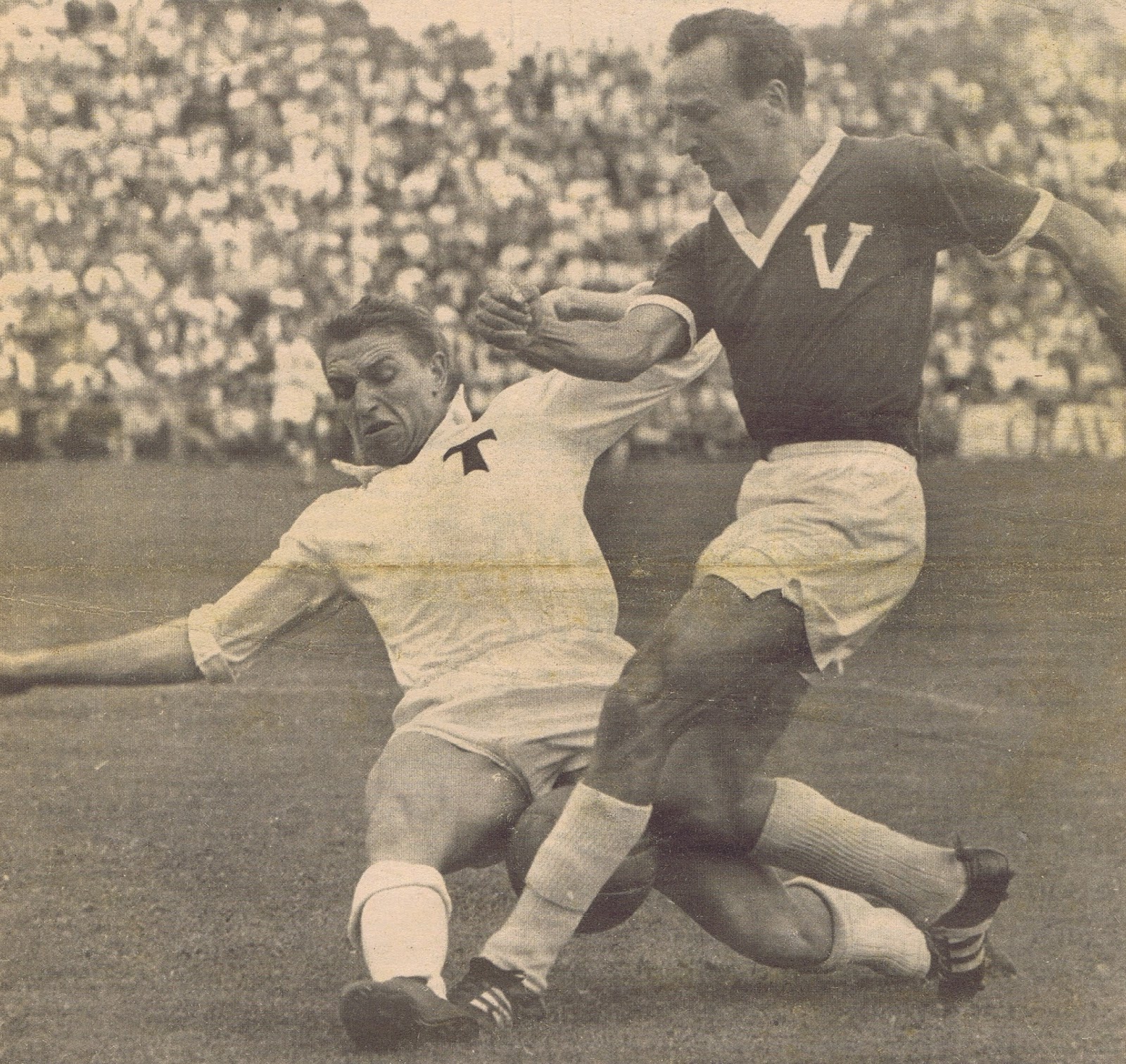
Another big crowd at Olympic Park watches Torpedo Moscow's Brednev go to ground as he tackles Victorian star Mike Jurecki in their 1965 clash.


On to another lost ground with this great wide shot of Middle Park in 1968.


Only just a star at the time, later to be a South Melbourne Hellas legend, Jimmy Pyrgolios in 1968.


A great Victorian state team from 1967. Willy Schroif, who played in a World Cup Final. Johnny Sanchez, an early Bill Fleming Medal winner. Jimmy Armstrong, goalscoring legend of Hakoah and South Melbourne Hellas who still helps out at Lakeside. Hammy McMeechan, who remained active in the game until his passing. Tommy Stankovic and Frank Micic, who were probably the two greatest ever J.U.S.T. players.


Nino Borsari, Olympic Gold Medalist, Patron of Victorian Football. A great gentleman of Carlton.


The ground remains, the grandstand does not. Action from Jubilee Park in 1963 as Layt of Ringwood Wilhelmina lead's Richmond Alemannia's Zammit to the ball in their VSL game.


Ringwood City 1982. Brooksy of the Music Men in the front row. Coached by Sjel de Bruyckere. Sjel was often referred to as Mike, but since the NCIP scandal I have amended all my records to include his proper name.
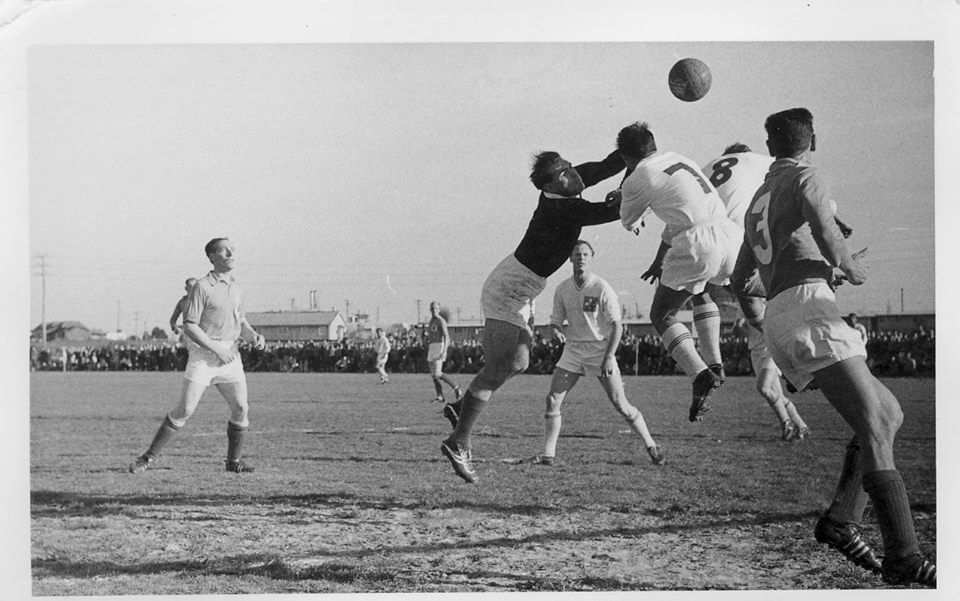


Richmond Alemannia player hi-jinx on the front page of Soccer News as Rudi van Altena holds back Peter Erasmus so Billy Copeland can cut his beard.


Prahran City team shot from 1969. Got the nod ahead of other team photographs found in Soccer News from that era simply because the goalkeeper is sporting a flat cap. You can't beat goalkeepers that wear flat caps.

                                                          (Click on images to enlarge)

Thursday, 14 April 2016

When Doves Fly

The second round of the Zagames State League Division Two South East season saw Doveton host Beaumaris at Waratah Reserve.


Doveton goalkeeper Stuart Webster, who's father Stan played for the club in the early 1980's, surveys the play further up the field. Webster was VPL Goalkeeper of the Year in 2003 (Frankston Pines) and 2012 (Dandenong Thunder). Keeping an eye on proceedings in the background is veteran goalkeeping coach Roy Lawton


The leafy surrounds of Waratah Reserve, with a hill beyond the park at the North Western end.


The Doveton bench, an impressive structure. Also ample and largely empty shelter down the Western side of the ground.


A rectangle of artificial turf means no unsightly bald patch at the entrance to the player's race.


Didier Imbert heads clear in the box.


The Press Box and more populated sheltered viewing area on the Eastern side of the ground.


Also on the Eastern side is the car park, clubrooms and heavy roller.


Another pitch in excellent condition, looking up the ground from South to North as Sean Seavill goes on the attack for Beaumaris.


David Gibson about to put the ball on the spot after Beaumaris were awarded a late first half penalty at 0-2 down.


Gibson beats Webster from the spot to get Beaumaris back into the game.


Doveton emerge for the second half, Roy Lawton catches up with Liam McCormick in the background.

Victorian State League and Victorian Premier League football was played at Waratah Reserve during Doveton's spells in the top flight during the 1980's and 1990's. On the other hand Beaumaris are currently at their highest ever level in competing in State Two South East.

Goals from Phoenix Lawton and Elliott David had Doveton 2-0 up before Beaumaris were awarded a contentious penalty before the break. Lawton's second goal seemed to have secured the win for the home side in the seventieth minute, but there was late drama as Beaumaris pulled a goal back in stoppage time. Holding on to their 3-2 lead saw the Doves keep their 100% winning record early in the new season.

                                                      (Click on images to enlarge)


Sunday, 6 March 2016

Grounds of the Past: MacDonald Reserve, Hawthorn East

In another case of it's hard to believe now, humble MacDonald Reserve (now known as Burke Road South Reserve, previously also known as Hawthorn South Reserve) hosted Victorian State League football as the home of Wilhelmina in the late 1950's and early 1960's.


The ground currently has no car park of it's own. There is very limited street parking on Sinclair Avenue. There have been many changes alongside the the ground since that time, which can be appreciated when we look at the Melways map from that era.


To the north, the drive in theatre became the Coles complex at Tooronga Village. The brickworks are long gone, and to the south Carroll Crescent disappeared to make way for the South Eastern Freeway. The majority of football patrons attending games would have come via trams down Burke Road or from the Gardiner train station.


The facilities are sparse. When I visited, cricketers using the nets at the south eastern end parked on the street and had no rooms to change in. The only structures on the site are a storage shed at the north eastern end, and another building further up the hill from it, which may have been the changing rooms when the ground was a VSL venue.


The quaint building sits near the storage shed, but it may also be that the current storage shed was even the changing room back then.


The view across the pitch looking from the east to the west. Behind the trees lies Gardiner's Creek and the Monash Freeway.


With it's lack of amenities, it's the hill on the Sinclair Avenue side that would have been a major attraction to the ground for Wilhelmina as a home. It would have been able to give the crowds they were drawing a decent view, a major problem in the days when standing behind the rope on a flat open park was the prime spectator location.


Another view of the storage shed, changing rooms behind it, and the eastern side of the ground.


Looking south, towards the cricket nets. Behind that would have been the bowling clubs, and further beyond would be Gardiner railway station.


Looking east from the south western corner shows how steep the hill is, and the limited amount of street parking around the ground.


The view when looking north to where the drive in cinema would have been, which is now the corporate headquarters of the Coles supermarket chain.

The ground is in excellent condition, as you would expect in the leafy inner eastern suburbs of Melbourne. Wilhelmina began playing there when promoted to the First Division in 1957, having previously used Survey Park in Burnley (later a home of Richmond Alemannia). The club also used Olympic and Middle Parks for home games in that era, but MacDonald Reserve was chiefly their home venue until they established Jubilee Park in Ringwood in 1962. The club then changed it's name to Ringwood City Wilhelmina, eventually becoming just Ringwood City.

Could the following picture be of the game between Wilhelmina and George Cross which drew 1400 spectators to MacDonald Reserve on Saturday August 12 in 1961?


If it is, it would had to have been taken from the north eastern side. It is possible that the buildings in the background could be a part of the brickworks. It's worth further investigation, as it would be great to have an image of top flight football from this long forgotten venue.

                                                         (Click on images to enlarge)

                    Edited to add photo from Wilhelmina v Juventus Dockerty Cup tie in 1956


Saturday, 19 September 2015

The Bastardisation of the Bill Fleming Medal

In 1954, The Argus newspaper awarded a medal for the best and fairest player in the V.A.S.F.A. First Division. Votes were issued on a 3-2-1 basis for each match, coordinated by football writer Bill Fleming. Though the paper ceased in 1957, the medal survived and was presented each year, re-named in honour of it's originator, Bill Fleming.

It was not until 1971 that the V.S.F. introduced it's own award for the best and fairest player in the Victorian State League each season, the Rothman's Medal, which eventually became the Gold Medal. Even then the Bill Fleming Medal survived, though no longer using the 3-2-1 system on every game format but instead taking a poll of the various members of the football media. The referees were used to implement the 3-2-1 system to determine the Rothman's Medal.

The point of difference for the Bill Fleming Medal then became that it allowed the more brilliant players to triumph over those that were simply more consistent. It also allowed for a mark of true greatness when a player was able to win the double of both medals.

For sixty years the Bill Fleming Medal was awarded to the best players in the top division of senior men's football in Victoria. The tradition spanned the First Division, Victorian State League, Victorian Premier League and National Premier League Victoria eras. It was older than the Gold Medal, and most clubs in the state. It was older than the VSF, the NSL or the FFA. This, in a sport that does not necessarily treasure it's own history, was quite remarkable.

This tradition was ended this year, when at the Gold Medal night it was announced the Bill Fleming Award would go to the player voted on by the FFV's match reporters (in lieu of independent media) as the best from the NPLV and WVPL. Not separate awards for each, but one for both. With the winner being Amy Jackson of Boroondara Eagles in the WVPL, the linage of winners of the Medal in the VSL/VPL/NPLV every year since 1954 has come to an end.

It is clear that the FFV has little respect for it's own history. Earlier this year it removed lies from it's own website when caught out attempting to re-write history on it. It drifts between being ashamed of most club's ethnic pasts and then appearing to embrace them as the need fits. We don't like your names or symbols, but look how tolerant we are munching down some souvlakis.

It's sad that a grand tradition (check out the honour roll) needs to be altered to make a political statement or push an agenda. Sadder still that lamenting the loss of such a tradition would see you labelled a misogynist.

Would I be a misogynist if I decried the Melbourne Cup being altered from the traditional 3200m into a 1200m sprint? If someone were to protest about men's grand slam tennis being reduced to best of three sets, are they being misogynistic? Are the AFL misogynists for not opening up their Brownlow Medal to women?

Tokenism is not true equality. If the change to the Bill Fleming Medal was initiated so the FFV could pat itself on the back for being so inclusive, it is a token act to my eye. It could have inaugurated a similar award for the WVPL and chosen to perhaps honour a female pioneer of football journalism (it's not like Bill Fleming himself ever wrote a single word about the women's game), but instead being able to tweet that "for the first time a @wplvictoria player has won the Bill Fleming Award" was the more politically beneficial gesture. Whoever decided that is truly the bastard who bastardised the Bill Fleming Medal.