Some more old VASFA and VSF Yearbooks have been scanned and uploaded to the Yearbooks & Annuals archive, and I thought I'd discuss their relative merits in a blog post.
Not a VSF Yearbook, the 1968 Victorian Soccer Yearbook
1968 Victorian Soccer Yearbook
Although a VSF product, this is not the actual VSF Yearbook for that year which can be found here.
It is basically a laws of the game booklet with last season's tables thrown in. Maybe they gave them out to schools for promotion/publicity, but even today I wouldn't waste thirty cents on it.
It cost shillings and pence, the 1959 VASFA Yearbook
1959 VASFA Yearbook
VASFA emblem on the cover, a lion and a kangaroo around a football with a crown on it. You could buy Stanley Matthews brand boots and balls in Queen Street. Good solid yearbook, list of VASFA officials and fixture list all nice. Slight shame the players are not identified in the picture of the previous year's State League Champions. Tables perfect, great results grids and cup charts. Slight let down with the list of champions, it's a shame Cup finals don't have further details as in scorers and line-ups. Some reasonable history with lists of previous champions and tours results. A quality production.
Here comes another one, just like the other one, the 1960 VASFA Yearbook
1960 VASFA Yearbook
Very similar to the previous year's version. The pic of the previous year's champion was ditched, and profiles of the leading officials was added. A good historical record.
It's a little bit different, but not in a good way, the 1966 VSF Yearbook
1966 VSF Yearbook
Cover photo is nice, Mike Jurecki of Victoria taking on Torpedo Moscow. Lists of officials and fixtures are all there, as well as additional editorial content with plenty of club profiles an a few photos. It fails to pass muster as a paper of record though, with the results grids and tables on covering the State League and Metropolitan League seniors only. No Cup charts, or even a list of winners, no state team match details, no reserves tables and no junior tables. G.T.Edgar, you are/were a fraud. Not fit to shine Stuart Beaton's shoes.
Gold on the cover but not enough gold, the 1970 VSF Yearbook
1970 VSF Yearbook
Nice action shot on the cover, but sadly the Hakoah and Hellas players aren't identified. Tables still unsatisfactory, none for reserves, the District League or the juniors, but some from interstate and country leagues. Cup charts are back, as are state team match details. Passable.
As old as me, the 1972 VSF Yearbook
1972 VSF Yearbook
Another unidentified player on the cover. Tables issue improving, with reserves, thirds and the District League back in the fold and only the juniors lacking. Cup charts and state team details all there, now with a review of all the State League clubs and a piece on the Argus Medal winner. There are team pics from state team games, again sadly unlabelled. Improving.
Entering the vintage era, the 1975 VSF Yearbook
1975 VSF Yearbook
Cover photo, with the team identified on page 8. What is this sorcery? Fixtures - even the Industrial League is included. Tables - seniors, reserves, thirds, District League and Provisional League. Only junior table included is an Under 20's league though. Gone - State League club reviews, results grids and state team details. Plenty of Cup charts though. On the verge of the Golden Age that was the 1977 and 1978 editions.
Showing posts with label South Melbourne Hellas. Show all posts
Showing posts with label South Melbourne Hellas. Show all posts
Saturday, 12 August 2017

Thursday, 12 January 2017
Just The Facts Ma'am - Part 1
The catchphrase "Just the facts, ma'am" is often attributed to the character Sgt. Joe Friday of pioneering U.S. television series Dragnet. The fact is, he never uttered those words. He would sometimes state "All we want are the facts, ma'am" or "All we know are the facts, ma'am" but it was a parody record by satirist Stan Freberg that led to the character having the catchphrase assigned to him. The movie L.A. Confidential features a television show called Badge of Honour, based on Dragnet, who's leading character uses the actual "Just the facts, ma'am" phrase.
So sometimes what is assumed to be a fact, really isn't. Myths can be formed from slight errors, but also deliberate lies can also come to be accepted as fact. There are many instances of both occurring in Australian football.
For many years, the wikipedia entry for goalkeeper Michael Turnbull was one of the great pieces of Australian fiction. Claiming almost 50 senior Socceroos caps, and more than that many first team appearances in the Serie A for Roma, the entry was taken as fact by ignorant journalists who pushed a story that he had knocked back a move to the Budesliga in late 2014. The entry had been toned down by the time he gained notoriety for embellishing his playing career on the "reality" tv series The Bachelorette. It's an example how falsehoods come into existence and can be accepted as truths, and why lazy media should be held to account.
Emile Damey
Former Nunawading City player Emile Damey gained some media exposure last year when he linked up with the Liberian national team for a training camp. This included a game, in which he scored, that the author of his wikipedia entry touts as his international debut.

(Click on all images to enlarge)
Now I'm not sure what the status of the game against Morocco was, but neither FIFA for the Liberian FA seemed to recognise it as a full international.

In the last few days that entry has been changed to note the game was against the Moroccan Under 23 team. His goals and appearances record for Nunawading City has also been amended. From 25 games and 10 goals across 2015-16 it now claims 13 games for 7 goals in 2015 and 19 games for 3 goals in 2016. The actual truth - who knows but I wouldn't trust that wikipedia page.
Sadly, some have.
http://www.fourfourtwo.com.au/news/dream-continues-after-african-adventure-437160
"Liberia were beaten by Tunisia in their final qualifying game with Damey failing to feature, however he did play in a friendly against Morocco, scoring with his first touch."
Reading that one would assume the friendly was a full International. It wasn't. Morocco's actual national team played a friendly the following day, in Albania. It's an important clarification that needed to be made, the fact that it wasn't makes you question the motives of those that published it.
South Melbourne
South Melbourne certainly has a long and storied history. Founded in 1959 as South Melbourne Hellas the club has won numerous titles in National and State competitions and represented Australia on the world stage at the World Club Cup.
In 2009 the International Federation of Football History and Statistics (IFFHS) awarded South Melbourne the title of Oceania Club of the Century and presented them with this trophy:

The club, and others, have since referred to this award as if it was issued by FIFA.

http://www.premier.vic.gov.au/labor-government-secures-south-melbournes-future-at-lakeside-stadium/
FIFA only issued one award for Club of the Century, to Real Madrid in December 2000. Real were presented with this trophy:

Real Madrid also picked up a trophy from the IFFHS in 2009 for European Club of the Century. Penarol, Asante Kotoko, Al-Hilal and Saprissa also collected IFFHS awarded for their respective Confederational Clubs of the Century.
Now undoubtedly a FIFA award is more prestigious than an IFFHS one, simply because most people would ask "Who?" if you brought up IFFHS while with FIFA they would know who you were talking about. Looking at the South Melbourne trophy it's clear to see it's an IFFHS one given the number of times/panels IFFHS appears on it.
For a club which rightly demands more respect for Australian football's past, it could do without the embellishment. When you play around with history you diminish it's credibility, and that does the game no favours.
So sometimes what is assumed to be a fact, really isn't. Myths can be formed from slight errors, but also deliberate lies can also come to be accepted as fact. There are many instances of both occurring in Australian football.
For many years, the wikipedia entry for goalkeeper Michael Turnbull was one of the great pieces of Australian fiction. Claiming almost 50 senior Socceroos caps, and more than that many first team appearances in the Serie A for Roma, the entry was taken as fact by ignorant journalists who pushed a story that he had knocked back a move to the Budesliga in late 2014. The entry had been toned down by the time he gained notoriety for embellishing his playing career on the "reality" tv series The Bachelorette. It's an example how falsehoods come into existence and can be accepted as truths, and why lazy media should be held to account.
Emile Damey
Former Nunawading City player Emile Damey gained some media exposure last year when he linked up with the Liberian national team for a training camp. This included a game, in which he scored, that the author of his wikipedia entry touts as his international debut.

(Click on all images to enlarge)
Now I'm not sure what the status of the game against Morocco was, but neither FIFA for the Liberian FA seemed to recognise it as a full international.

In the last few days that entry has been changed to note the game was against the Moroccan Under 23 team. His goals and appearances record for Nunawading City has also been amended. From 25 games and 10 goals across 2015-16 it now claims 13 games for 7 goals in 2015 and 19 games for 3 goals in 2016. The actual truth - who knows but I wouldn't trust that wikipedia page.
Sadly, some have.
http://www.fourfourtwo.com.au/news/dream-continues-after-african-adventure-437160
"Liberia were beaten by Tunisia in their final qualifying game with Damey failing to feature, however he did play in a friendly against Morocco, scoring with his first touch."
Reading that one would assume the friendly was a full International. It wasn't. Morocco's actual national team played a friendly the following day, in Albania. It's an important clarification that needed to be made, the fact that it wasn't makes you question the motives of those that published it.
South Melbourne
South Melbourne certainly has a long and storied history. Founded in 1959 as South Melbourne Hellas the club has won numerous titles in National and State competitions and represented Australia on the world stage at the World Club Cup.
In 2009 the International Federation of Football History and Statistics (IFFHS) awarded South Melbourne the title of Oceania Club of the Century and presented them with this trophy:

The club, and others, have since referred to this award as if it was issued by FIFA.

http://www.premier.vic.gov.au/labor-government-secures-south-melbournes-future-at-lakeside-stadium/
FIFA only issued one award for Club of the Century, to Real Madrid in December 2000. Real were presented with this trophy:

Real Madrid also picked up a trophy from the IFFHS in 2009 for European Club of the Century. Penarol, Asante Kotoko, Al-Hilal and Saprissa also collected IFFHS awarded for their respective Confederational Clubs of the Century.
Now undoubtedly a FIFA award is more prestigious than an IFFHS one, simply because most people would ask "Who?" if you brought up IFFHS while with FIFA they would know who you were talking about. Looking at the South Melbourne trophy it's clear to see it's an IFFHS one given the number of times/panels IFFHS appears on it.
For a club which rightly demands more respect for Australian football's past, it could do without the embellishment. When you play around with history you diminish it's credibility, and that does the game no favours.
Tuesday, 13 December 2016
Vale Dave Maclaren
Scottish goalkeeper Dave Maclaren, who arrived in Australia to coach in the 1970's passed away in Castlemaine last week after a long illness.
A player with Dundee, Leicester City, Plymouth Argyle, Wolverhampton Wanderers and Southampton he came to Australia after a spell as national team coach of Malaysia, starting in Sydney (with Hakoah) before settling in Victoria. He coached South Melbourne Hellas in the NSL in 1978 and George Cross in the VSL in 1979.
His brother Roy was a goalkeeper for St Johnstone, Bury and Sheffield Wednesday. Roy also emigrated to Australia, coaching various clubs in the VSL. Roy was first team coach at Aston Villa during their great late 1970's-early 1980's era which included winning the First Division Championship and European Cup. Roy's son Bruce played for South Melbourne Hellas, most notably in their 1990-91 Championship winning team. The goalkeeping family extends to Roy's grandsons, with Alistair Bray at Melbourne Victory and Fraser Maclaren at Dandenong Thunder.
There's a great interview with Dave on the Wolves Heroes website and a fine obituary in the Plymouth Herald.

Edited to add the link to Soccer Action reporting Maclaren being appointed coach of South Melbourne Hellas.
A player with Dundee, Leicester City, Plymouth Argyle, Wolverhampton Wanderers and Southampton he came to Australia after a spell as national team coach of Malaysia, starting in Sydney (with Hakoah) before settling in Victoria. He coached South Melbourne Hellas in the NSL in 1978 and George Cross in the VSL in 1979.
His brother Roy was a goalkeeper for St Johnstone, Bury and Sheffield Wednesday. Roy also emigrated to Australia, coaching various clubs in the VSL. Roy was first team coach at Aston Villa during their great late 1970's-early 1980's era which included winning the First Division Championship and European Cup. Roy's son Bruce played for South Melbourne Hellas, most notably in their 1990-91 Championship winning team. The goalkeeping family extends to Roy's grandsons, with Alistair Bray at Melbourne Victory and Fraser Maclaren at Dandenong Thunder.
There's a great interview with Dave on the Wolves Heroes website and a fine obituary in the Plymouth Herald.
Edited to add the link to Soccer Action reporting Maclaren being appointed coach of South Melbourne Hellas.
Sunday, 27 November 2016
George Campbell Returns To Aberdeen
Since the beginning of the game in Melbourne, the Scots have been significant contributors to Victorian football. Many early games were drawn along Scotland v England lines, before Harry Dockerty would revive organised competitions in 1909. The importation of Scottish players throughout the 1950's and 1960's saw the standard of Australian football rise to a level which saw the Socceroos able to qualify for the 1974 World Cup Finals.
The signing of a young Scot by South Melbourne Hellas in 1978 created a stir in the football scene, as covered in Soccer Action at the time:
Soccer Action Vol.3 No.11 - Wednesday April 19, 1978
Soccer Action Vol.3 No.15 - Wednesday May 10, 1978
George Campbell had been the youngest ever player to play for Aberdeen. He came on a sixteen year old substitute against Morton in 1975 to make his First Division (current Premiership) debut. Hellas paid a record fee of $20,000 to secure the skillful, tricky youngster already dubbed "The White Pele". In five seasons at Middle Park he would score 17 goals from 104 appearances with the club reaching a best ever NSL placing to that point when Runner's-Up in 1981.

George Campbell at Aberdeen
In 1983 Campbell made the move to NSL rivals Preston Makedonia where he played for three seasons before a transfer to Green Gully in 1986. During his time in the NSL the former Scottish Youth International would occasionally feature for the Victorian State Team. Some of these games included the 2-1 win over Dundee in 1978 and a thrilling 2-3 loss to a star-studded New York Cosmos in 1983.
His time in the NSL was followed by stints with Box Hill (1987-1989) and Fawkner (1989) in the VSL (current NPL). He then continued playing in the lower State League with Nunawading City, then Ringwood City, Knox City and Banyule City until 1998. After an early broken leg which scuppered plans for a return to Scottish League football he would enjoy a career spanning 20 years in Melbourne.
Since retiring as a player he has been coaching in club, academy and school capacities. As well as roles with the FFV and Xavier College he has been involved with the Youth teams at Essendon Royals, Northcote City and his current club Dandenong Thunder.
In October this year he returned to Scotland for a reunion lunch for the anniversary of Aberdeen's 1976 Scottish League Cup win. A special programme was made for the event:


It's fantastic to see a club that celebrates it's past in such a manner. Well done to George on his achievements and his continued involvement in the local game.
(Click on images to enlarge)
The signing of a young Scot by South Melbourne Hellas in 1978 created a stir in the football scene, as covered in Soccer Action at the time:
Soccer Action Vol.3 No.11 - Wednesday April 19, 1978
Soccer Action Vol.3 No.15 - Wednesday May 10, 1978
George Campbell had been the youngest ever player to play for Aberdeen. He came on a sixteen year old substitute against Morton in 1975 to make his First Division (current Premiership) debut. Hellas paid a record fee of $20,000 to secure the skillful, tricky youngster already dubbed "The White Pele". In five seasons at Middle Park he would score 17 goals from 104 appearances with the club reaching a best ever NSL placing to that point when Runner's-Up in 1981.
George Campbell at Aberdeen
In 1983 Campbell made the move to NSL rivals Preston Makedonia where he played for three seasons before a transfer to Green Gully in 1986. During his time in the NSL the former Scottish Youth International would occasionally feature for the Victorian State Team. Some of these games included the 2-1 win over Dundee in 1978 and a thrilling 2-3 loss to a star-studded New York Cosmos in 1983.
His time in the NSL was followed by stints with Box Hill (1987-1989) and Fawkner (1989) in the VSL (current NPL). He then continued playing in the lower State League with Nunawading City, then Ringwood City, Knox City and Banyule City until 1998. After an early broken leg which scuppered plans for a return to Scottish League football he would enjoy a career spanning 20 years in Melbourne.
Since retiring as a player he has been coaching in club, academy and school capacities. As well as roles with the FFV and Xavier College he has been involved with the Youth teams at Essendon Royals, Northcote City and his current club Dandenong Thunder.
In October this year he returned to Scotland for a reunion lunch for the anniversary of Aberdeen's 1976 Scottish League Cup win. A special programme was made for the event:


It's fantastic to see a club that celebrates it's past in such a manner. Well done to George on his achievements and his continued involvement in the local game.
(Click on images to enlarge)
Tuesday, 31 May 2016
Random Black and White Photos
Since belatedly discovering that Microsoft Paint and Microsoft Photo are a little more advanced on Windows 10 than they were on Microsoft XP over ten years ago, I thought I'd go through some documents and cut, paste, straighten and crop some old photos.

A shot from the famous 1962 VSL game between South Melbourne Hellas and George Cross at Olympic Park. The stands are a mass of humanity, as over 22,000 people crowded the venue.

Another big crowd at Olympic Park watches Torpedo Moscow's Brednev go to ground as he tackles Victorian star Mike Jurecki in their 1965 clash.

On to another lost ground with this great wide shot of Middle Park in 1968.

Only just a star at the time, later to be a South Melbourne Hellas legend, Jimmy Pyrgolios in 1968.

A great Victorian state team from 1967. Willy Schroif, who played in a World Cup Final. Johnny Sanchez, an early Bill Fleming Medal winner. Jimmy Armstrong, goalscoring legend of Hakoah and South Melbourne Hellas who still helps out at Lakeside. Hammy McMeechan, who remained active in the game until his passing. Tommy Stankovic and Frank Micic, who were probably the two greatest ever J.U.S.T. players.

Nino Borsari, Olympic Gold Medalist, Patron of Victorian Football. A great gentleman of Carlton.

The ground remains, the grandstand does not. Action from Jubilee Park in 1963 as Layt of Ringwood Wilhelmina lead's Richmond Alemannia's Zammit to the ball in their VSL game.

Ringwood City 1982. Brooksy of the Music Men in the front row. Coached by Sjel de Bruyckere. Sjel was often referred to as Mike, but since the NCIP scandal I have amended all my records to include his proper name.

Richmond Alemannia player hi-jinx on the front page of Soccer News as Rudi van Altena holds back Peter Erasmus so Billy Copeland can cut his beard.

Prahran City team shot from 1969. Got the nod ahead of other team photographs found in Soccer News from that era simply because the goalkeeper is sporting a flat cap. You can't beat goalkeepers that wear flat caps.
(Click on images to enlarge)

A shot from the famous 1962 VSL game between South Melbourne Hellas and George Cross at Olympic Park. The stands are a mass of humanity, as over 22,000 people crowded the venue.
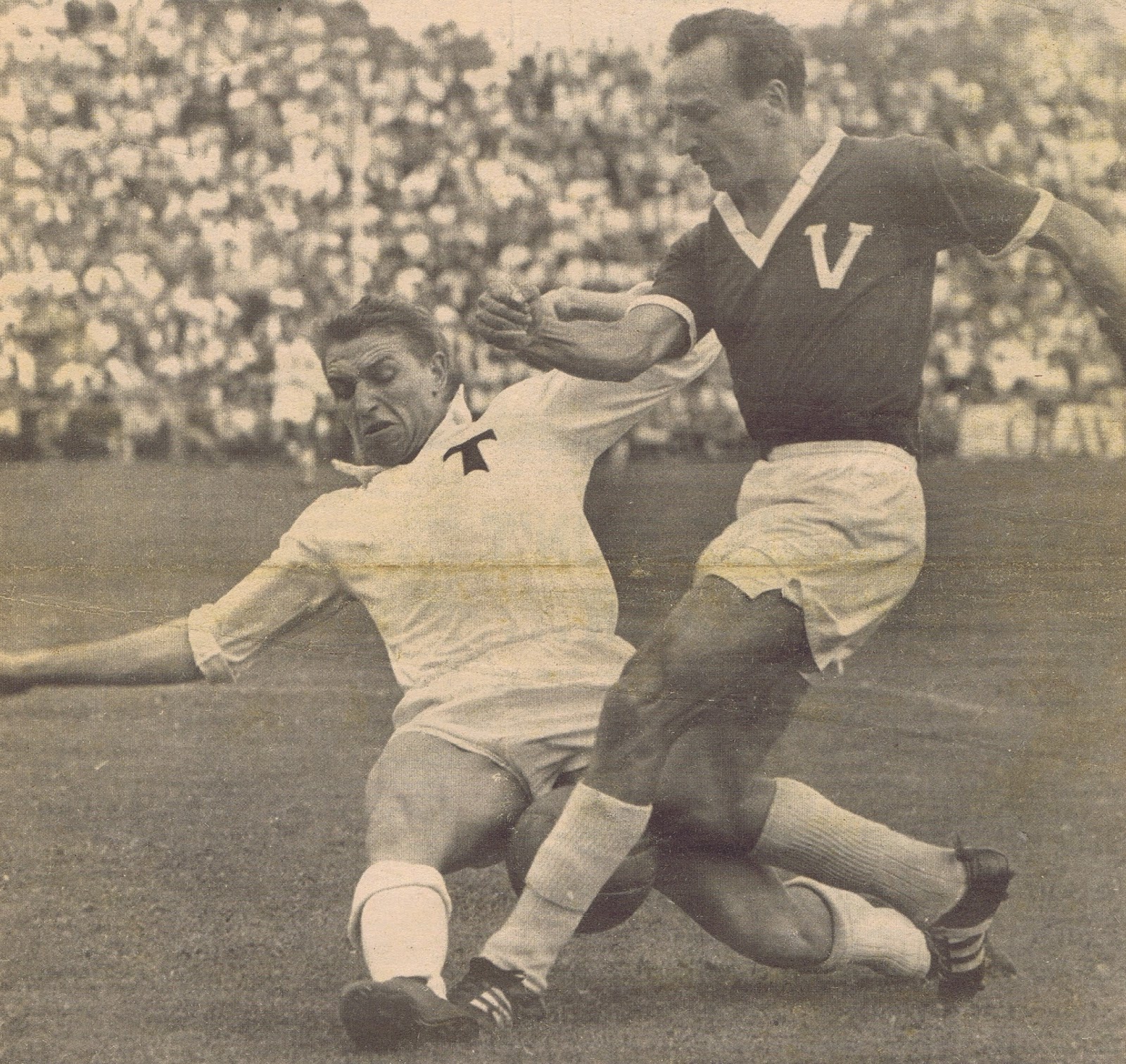
Another big crowd at Olympic Park watches Torpedo Moscow's Brednev go to ground as he tackles Victorian star Mike Jurecki in their 1965 clash.

On to another lost ground with this great wide shot of Middle Park in 1968.

Only just a star at the time, later to be a South Melbourne Hellas legend, Jimmy Pyrgolios in 1968.

A great Victorian state team from 1967. Willy Schroif, who played in a World Cup Final. Johnny Sanchez, an early Bill Fleming Medal winner. Jimmy Armstrong, goalscoring legend of Hakoah and South Melbourne Hellas who still helps out at Lakeside. Hammy McMeechan, who remained active in the game until his passing. Tommy Stankovic and Frank Micic, who were probably the two greatest ever J.U.S.T. players.

Nino Borsari, Olympic Gold Medalist, Patron of Victorian Football. A great gentleman of Carlton.

The ground remains, the grandstand does not. Action from Jubilee Park in 1963 as Layt of Ringwood Wilhelmina lead's Richmond Alemannia's Zammit to the ball in their VSL game.

Ringwood City 1982. Brooksy of the Music Men in the front row. Coached by Sjel de Bruyckere. Sjel was often referred to as Mike, but since the NCIP scandal I have amended all my records to include his proper name.

Richmond Alemannia player hi-jinx on the front page of Soccer News as Rudi van Altena holds back Peter Erasmus so Billy Copeland can cut his beard.

Prahran City team shot from 1969. Got the nod ahead of other team photographs found in Soccer News from that era simply because the goalkeeper is sporting a flat cap. You can't beat goalkeepers that wear flat caps.
(Click on images to enlarge)
Thursday, 16 October 2014
Soccer News, Of Late 1965
I've reduce copied, scanned and uploaded four issues of Soccer News from 1965:
Thursday August 12
Thursday October 14
Thursday November 18
Thursday November 25
Morrie Buckner had page two, with Jim Cook having the back page. Martyn Harris did a round-up of the Metropolitan League. Fred Villiers was editor.
In the August 12 issue, one of the letters to the editor came from controversial J.U.S.T. President Tony Kovac. South Melbourne Hellas sat top of the State League. Jim Cook asks has the Argus Medal had it, and it has because the award would eventually be renamed in honour of Bill Fleming.
The October 14 edition came after the conclusion of the league competitions. The Australia and Dockerty Cups were being contested, and the silly season of interstate/national league talk was underway. Victoria, a first division club from Adelaide, defeated Richmond Alemannia 2-1, probably taking the crown of top German club in Australia in the process. George Scott of Juventus won the Argus Medal, which was presented to him by Stuart Beaton on Channel 7's World of Sport the previous Sunday.
A Dockerty Cup Final preview can be found in the November 18 issue, with Croatia and Slavia set to face-off. Page 4 features a special on South Australian football. Jim Cook's page reveals the chance to see films of Torpedo Moscow v Victoria and Torpedo Moscow v New South Wales at North Melbourne Town Hall. I wonder if those films still exist somewhere?
The Cambodia Catastrophe is covered in the November 25 number. Australia's World Cup qualification chances were crushed with a 6-1 loss against North Korea in Phnom Penh. A double page centrespread celebrates Slavia winning the Dockerty Cup Final. Jim Cook's page list a few honours, including Tommy McPherson (George Cross) winning the Soccer News Best and Fairest Award, with Alistair Scott (Melbourne) taking out the Sporting Globe Best and Fairest Award for the State League. Again, highlights of the Adelaide Croatia v Melbourne Croatia match were shown on Channel 9 in Adelaide the previous week. Another treasure probably lost.
Thursday August 12
Thursday October 14
Thursday November 18
Thursday November 25
Morrie Buckner had page two, with Jim Cook having the back page. Martyn Harris did a round-up of the Metropolitan League. Fred Villiers was editor.
In the August 12 issue, one of the letters to the editor came from controversial J.U.S.T. President Tony Kovac. South Melbourne Hellas sat top of the State League. Jim Cook asks has the Argus Medal had it, and it has because the award would eventually be renamed in honour of Bill Fleming.
The October 14 edition came after the conclusion of the league competitions. The Australia and Dockerty Cups were being contested, and the silly season of interstate/national league talk was underway. Victoria, a first division club from Adelaide, defeated Richmond Alemannia 2-1, probably taking the crown of top German club in Australia in the process. George Scott of Juventus won the Argus Medal, which was presented to him by Stuart Beaton on Channel 7's World of Sport the previous Sunday.
A Dockerty Cup Final preview can be found in the November 18 issue, with Croatia and Slavia set to face-off. Page 4 features a special on South Australian football. Jim Cook's page reveals the chance to see films of Torpedo Moscow v Victoria and Torpedo Moscow v New South Wales at North Melbourne Town Hall. I wonder if those films still exist somewhere?
The Cambodia Catastrophe is covered in the November 25 number. Australia's World Cup qualification chances were crushed with a 6-1 loss against North Korea in Phnom Penh. A double page centrespread celebrates Slavia winning the Dockerty Cup Final. Jim Cook's page list a few honours, including Tommy McPherson (George Cross) winning the Soccer News Best and Fairest Award, with Alistair Scott (Melbourne) taking out the Sporting Globe Best and Fairest Award for the State League. Again, highlights of the Adelaide Croatia v Melbourne Croatia match were shown on Channel 9 in Adelaide the previous week. Another treasure probably lost.
Wednesday, 20 August 2014
Any chance of an explanation?
There's been a bit of debate about the FFA's National Club Identity Policy. Those who support it have pointed out that it is not being applied retrospectively, often ignoring that previous purges from the governing bodies have already seen clubs forced into changing parts of their identity (names and emblems). South Melbourne Hellas became just South Melbourne, Melbourne Croatia became Melbourne Knights, Heidelberg Alexander became Heidelberg United and the list goes on. Marconi were forced to remove the colours of the Italian flag that were on the boomerang in their emblem.
Which is why I was surprised to see this recently:

Under changes forced on other clubs by the VSF years ago, the name Maccabi appearing on this website, and the star featured in the emblem would contravene FFV rules of competition.
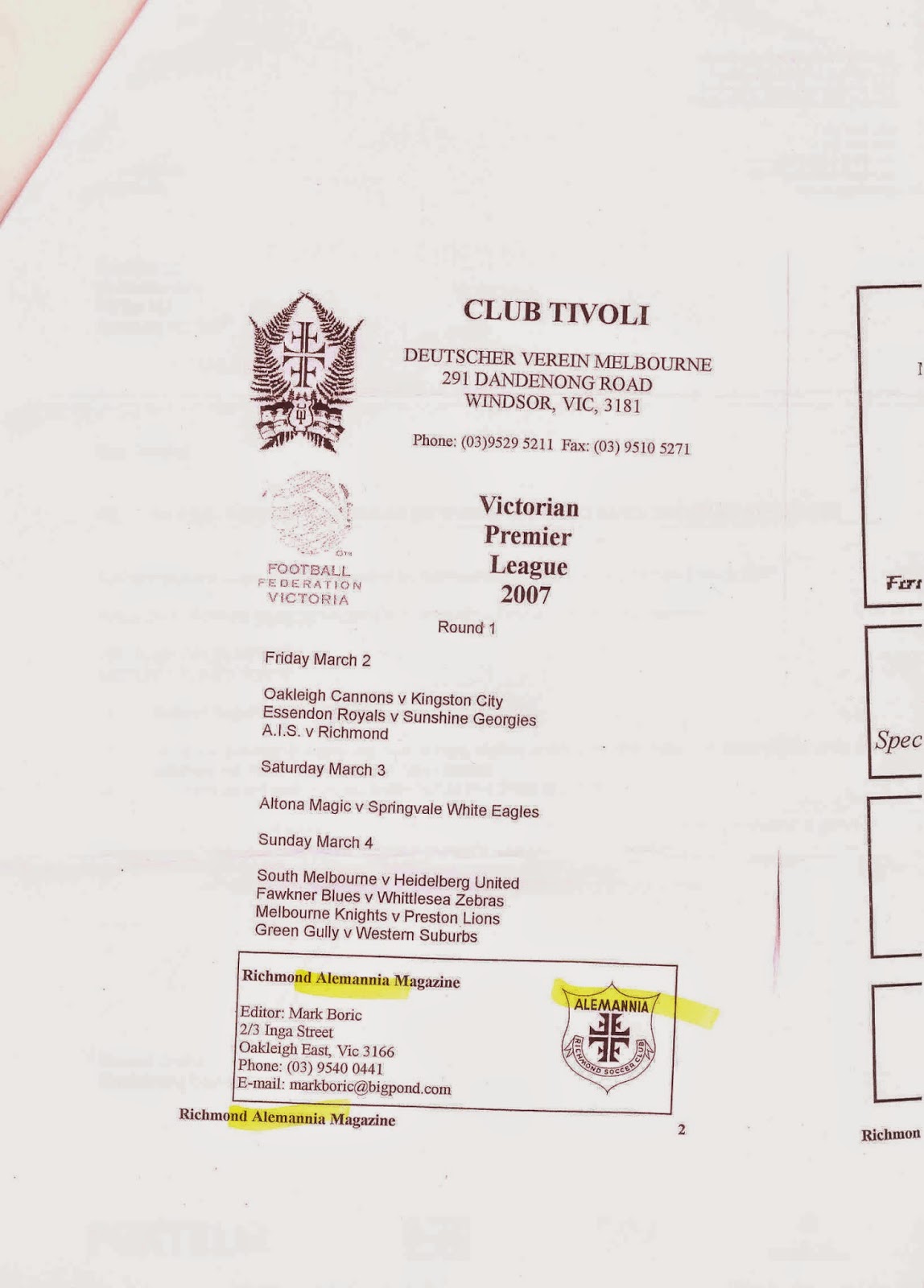
Here's an explanation from the FFV's Maxwell Gratton from 2007:


(Click on images to enlarge)
As highlighted by the FFV, the name "Alemannia" appearing alongside the club name and in the version of the club emblem was unacceptable. It poses the question as to whether the FFV discriminates against some clubs in how it enforces it's rules.
When I started Richmond Alemannia Magazine in 2002, the Alemannia name had officially been removed for many years. Even in the 1960's, the club generally appeared on league tables as just Richmond. I put the name in the title as a tribute to the tradition of the club, not in any attempt to spread German nationalism. It was as much a fanzine at times as a programme.
You may note the date on the letter is March 22nd, 2007. It arrived on the day of a home game against Essendon Royals, when 150 copies of that week's magazine had been printed and stapled. As a result of the letter, these were not allowed to be distributed. Annoying, but is any club volunteer not really wasting time that could be better spent elsewhere anyway?
So I tweeted the official FFV account to ask for an explanation. Could I be mistaken in my assumption that the rules are not being applied consistently? I'm willing to be convinced, but as yet there are no takers.
Which is why I was surprised to see this recently:
Under changes forced on other clubs by the VSF years ago, the name Maccabi appearing on this website, and the star featured in the emblem would contravene FFV rules of competition.
Here's an explanation from the FFV's Maxwell Gratton from 2007:
(Click on images to enlarge)
As highlighted by the FFV, the name "Alemannia" appearing alongside the club name and in the version of the club emblem was unacceptable. It poses the question as to whether the FFV discriminates against some clubs in how it enforces it's rules.
When I started Richmond Alemannia Magazine in 2002, the Alemannia name had officially been removed for many years. Even in the 1960's, the club generally appeared on league tables as just Richmond. I put the name in the title as a tribute to the tradition of the club, not in any attempt to spread German nationalism. It was as much a fanzine at times as a programme.
You may note the date on the letter is March 22nd, 2007. It arrived on the day of a home game against Essendon Royals, when 150 copies of that week's magazine had been printed and stapled. As a result of the letter, these were not allowed to be distributed. Annoying, but is any club volunteer not really wasting time that could be better spent elsewhere anyway?
@footballvic Any chance of an explanation? http://t.co/vC9FRzbNPn pic.twitter.com/R8U14ZxDb2
— Mark Boric (@MarkBoric) August 18, 2014
So I tweeted the official FFV account to ask for an explanation. Could I be mistaken in my assumption that the rules are not being applied consistently? I'm willing to be convinced, but as yet there are no takers.
Monday, 28 April 2014
Random Research Musings
After two days in which I arrived at the SLV newspaper reading room at 10.a.m and didn't leave until just before 6.00 p.m. closing (without any food, drink or toilet breaks) in a week and then trying to make sense of my appalling note-taking, I may as well share what little discoveries I made.
Deciding to work back in time for a change I had a look for reserve's league champions, League Best and Fairest and Top Goalscorers from the early and mid 2000's. Gave up on that pretty quickly as it was futile. It's stuff that should already be available on the net but to to incompetence it isn't. For another day.
I then moved on to mid and early 1990's Cup Finals of the State League, Provisional League, Amateur League and Armstrong variety. A bit more success here. Found the line-ups for the 1992 Dockerty Cup Final, as well as the score from the curtain raiser, a 1-1 draw between the Victorian state team and South Melbourne Hellas.
1991 saw a play-off between the NSWPL and VPL champions. It was Sutherland v Brunswick Juventus over two legs. Both won 1-0 at home (home city in the case of Juve who used Northcote's John Cain Reserve) leading to a penalty shoot-out won 4-3 by Brunswick.
Always a bittersweet moment finding a Cup final line-ups but no record of the substitutions made. That was in the case of the 1990 Dockerty Cup Final. Melbourne Croatia only had two on the bench, whilst Brunswick Juventus had the full five, with Charlie Egan at least being brought on being gleaned from one match report.
OzFootball has the South Melbourne line-up for the infamous 1988 Dockerty Cup Final, but not that of Melbourne Croatia. Which is of main interest being the Final is infamous for seeing winners Croatia stripped of their win on protest after bringing on Frank Valentic as sub when he was under suspension from a Youth league game apparently. Did not find their full line-up or substitutions.
Found enough scores from 1954 to finalise the Third Division table. Almost enough to do the same for the Fourth Division, though that picture is muddied by Shell and Slovakia both pulling out, and Victorian Colts being added halfway through the season.
A puzzle stubbornly refusing to be solves is the Third Division of 1951. One score missing, Coburg v Olympic from June 30. I know Coburg won, because going on promotion/relegation the next season they must have secured the two points they needed to jump from fourth to second. The Coburg Courier has the score from the week before and after, but not that week.
Still don't have full line-ups for the 1958, 1959 and 1970's Dockerty Cup Finals. I must say the The Sun's Morrie Buckner was the worst of the old time correspondents I've come across. One match report barely mentioned a single player amid his whinging about the pitch and weather.
Since then I've had a look at some missing goalscorers from the OzFootball records), as I still think that working out a lineage of Top Goalscorers for the VSL/VPL back to 1960 is possible. As of now, there are seven goals unaccounted for in 1964. Will need to go back to see if there are any details around on the replayed game of Alexander 1 Melbourne 3 on Wednesday September 9. As it stands, Mike Mandalis of South Melbourne Hellas heads the list on 16, with all of South's goals accounted for. This puts him two clear of Frank Soffels from Willhelmina, who have one goal missing, so he has him covered. Jimmy Malloy of Melbourne sits on 13, and a hat-trick in that game would have him share honours, and it may be possible because he did most of his scoring in braces or hat-tricks that year.
I've found the missing scorers for 1967, and it was a climactic finish tallying the goals. Tony Hughes of J.U.S.T. scored twice in the final round to draw level on 19 with Jimmy Armstrong (Hakoah) and Attila Abonyi (Melbourne) who went head to head at Middle Park. Abonyi scored the only goal of the game to clinch the Golden Boot.
In 1961 four games from the Public Holiday Monday round on April 3rd remain elusive in terms of goalscorer details. And I mean elusive. Tried the Italian paper Il Globo, as Juventus played Richmond Alemannia that day, but they only covered the subsequent Saturday game in their next issue. Tried the German newspaper Neue Welt and would you believe it there was a "this issue is missing" slide on the microfilm for the relevant week, the only one on a reel covering two years worth of the paper. A tally of the goals sees Alex Beattie of J.U.S.T. on top with 21 goals, again with all their goals accounted for. Joe Haasz is the only one who can catch him, sitting on 19 and with both goals in Slavia's 4-2 loss to Moreland that fateful day still unknown.
Deciding to work back in time for a change I had a look for reserve's league champions, League Best and Fairest and Top Goalscorers from the early and mid 2000's. Gave up on that pretty quickly as it was futile. It's stuff that should already be available on the net but to to incompetence it isn't. For another day.
I then moved on to mid and early 1990's Cup Finals of the State League, Provisional League, Amateur League and Armstrong variety. A bit more success here. Found the line-ups for the 1992 Dockerty Cup Final, as well as the score from the curtain raiser, a 1-1 draw between the Victorian state team and South Melbourne Hellas.
1991 saw a play-off between the NSWPL and VPL champions. It was Sutherland v Brunswick Juventus over two legs. Both won 1-0 at home (home city in the case of Juve who used Northcote's John Cain Reserve) leading to a penalty shoot-out won 4-3 by Brunswick.
Always a bittersweet moment finding a Cup final line-ups but no record of the substitutions made. That was in the case of the 1990 Dockerty Cup Final. Melbourne Croatia only had two on the bench, whilst Brunswick Juventus had the full five, with Charlie Egan at least being brought on being gleaned from one match report.
OzFootball has the South Melbourne line-up for the infamous 1988 Dockerty Cup Final, but not that of Melbourne Croatia. Which is of main interest being the Final is infamous for seeing winners Croatia stripped of their win on protest after bringing on Frank Valentic as sub when he was under suspension from a Youth league game apparently. Did not find their full line-up or substitutions.
Found enough scores from 1954 to finalise the Third Division table. Almost enough to do the same for the Fourth Division, though that picture is muddied by Shell and Slovakia both pulling out, and Victorian Colts being added halfway through the season.
A puzzle stubbornly refusing to be solves is the Third Division of 1951. One score missing, Coburg v Olympic from June 30. I know Coburg won, because going on promotion/relegation the next season they must have secured the two points they needed to jump from fourth to second. The Coburg Courier has the score from the week before and after, but not that week.
Still don't have full line-ups for the 1958, 1959 and 1970's Dockerty Cup Finals. I must say the The Sun's Morrie Buckner was the worst of the old time correspondents I've come across. One match report barely mentioned a single player amid his whinging about the pitch and weather.
Since then I've had a look at some missing goalscorers from the OzFootball records), as I still think that working out a lineage of Top Goalscorers for the VSL/VPL back to 1960 is possible. As of now, there are seven goals unaccounted for in 1964. Will need to go back to see if there are any details around on the replayed game of Alexander 1 Melbourne 3 on Wednesday September 9. As it stands, Mike Mandalis of South Melbourne Hellas heads the list on 16, with all of South's goals accounted for. This puts him two clear of Frank Soffels from Willhelmina, who have one goal missing, so he has him covered. Jimmy Malloy of Melbourne sits on 13, and a hat-trick in that game would have him share honours, and it may be possible because he did most of his scoring in braces or hat-tricks that year.
I've found the missing scorers for 1967, and it was a climactic finish tallying the goals. Tony Hughes of J.U.S.T. scored twice in the final round to draw level on 19 with Jimmy Armstrong (Hakoah) and Attila Abonyi (Melbourne) who went head to head at Middle Park. Abonyi scored the only goal of the game to clinch the Golden Boot.
In 1961 four games from the Public Holiday Monday round on April 3rd remain elusive in terms of goalscorer details. And I mean elusive. Tried the Italian paper Il Globo, as Juventus played Richmond Alemannia that day, but they only covered the subsequent Saturday game in their next issue. Tried the German newspaper Neue Welt and would you believe it there was a "this issue is missing" slide on the microfilm for the relevant week, the only one on a reel covering two years worth of the paper. A tally of the goals sees Alex Beattie of J.U.S.T. on top with 21 goals, again with all their goals accounted for. Joe Haasz is the only one who can catch him, sitting on 19 and with both goals in Slavia's 4-2 loss to Moreland that fateful day still unknown.
Subscribe to:
Posts (Atom)