Showing posts with label FFA. Show all posts

Sunday, 10 March 2019

Evaporating History


Back in 2001 Roy Hay put out this appeal for old issues of Soccer News to aid in football research. It took up about an eighth of a page in Australian and British Soccer Weekly. I think I ended up going to the Oakleigh Public Library to makes photocopies (Pre-Officeworks days) of two issues that I had that he didn't to send to him. His collection can now be found at the MCC Library. I don't think the State Library would microfilm a collection which was so far from being complete.

What staggers, and infuriates, me is eighteen years later no governing body of the game has made any sort of concerted effort to make a similar appeal to redress the vanishing history of our game in this country. In these years how many more old newspapers, programmes, photos and yearbooks have ended up in landfill, many lost forever. We have competition histories that are incomplete and the resources to try and remedy that continue to disappear.

It makes me think of Dr Ian Syson's The Game That Never Happened. We have history rotting away, and only have ourselves to blame. Six paragraphs in ABSW in 2001, in one issue. Today we have social media. The FFA twitter account has 150,000 followers, Football Victoria over 11,000. There is a far greater platform now to appeal for historical documents by these well-staffed organisations, yet there has been absolutely nothing done. If they truly loved the game, these people would be ashamed.

                                      (Click on image to enlarge)


Wednesday, 8 March 2017

Elitist But Not Elite

In the week FFA Technical Director Eric Abrams was critical of the NPL it's opportune to take a look back how Victoria came to adopt such a flawed version of it.

The part of the Why I've Arrived Where I'm At piece that seems to have struck a chord with many was the passion, dedication and loyalty of those who get deeply involved with a club. While it may have resonated with football people who have been in similar situations, it probably wouldn't be understood by the architects of the FFV's original NPLV model.

That model was an attempt to supplant the existing VPL club structure with a zonal franchise model. The first push in this direction was the old Summer League, which later became the Victorian Champions League. These leagues were only able to get off the ground as junior competitions, with the senior component dropped due to lack of interest in anyone willing to establish and run these teams.

People volunteer at clubs for all sorts of reasons. It may be a link to a particular ethnic community, it may be because they live within a goalkeeper's clearance of the home ground. Some will stay on at a club in various roles after playing, others are drawn by family members being involved. Whatever the reason, most are loyal to their club and will only ever perform the duties they do at one club during their lifetime.

It's an indictment on those running the game at the time that they thought it possible that there'd be a groundswell of people willing to set-up and run new zonal clubs just because they would be part of some kind of "elite" pathway. The lure of being labelled "elite" is not enough to sway your typical club volunteer to shift their loyalties. It may induce a parent looking to give their child's career a "leg-up", but that alone would not secure the numbers and dollars required to get the venture up and running.

The FFV would have preferred to have installed a zonal set-up when introducing the NPLV a few years later, but settled for a system in which existing clubs would be chosen to represent the respective zones. Again it's staggering to believe that supposed football people thought this would be a workable idea.

With the new top tier to be a closed league, the "elite" clubs would sit above subservient "community" clubs in their zone. Even with the obvious issues posed by the ethnic backgrounds of many clubs, it was a concept that would alienate all those not included in the new league. How could you expect clubs that may have been rivals to another for years that they would now have to be a feeder team for that club? That they could no longer aspire to promotion back to the top tier?

So not surprisingly, there was rebellion. Clubs took the FFV to court to have their own version of the NPLV implemented, and the resulting compromise has largely been a disaster. Instead of an actual elite competition we have a watered-down, bloated debacle. Have kids with genuine talent been priced out of the game by the significant fees required to be involved? Will extended seasons involving plenty of travel see others burnt out before they are even ready for senior football?

The compromise saw a two-tier NPL established, to include any club (from the existing VPL and State League Division One) which may have had a grievance at being left out. Regional teams were included, in a manner which has not enhanced their future prosperity. Somehow, after a few years, Nunawading City were added despite having slid down the State League.

Looking at the areas of the regional teams, the first thing one may wonder is how is it that Gippsland could have a team in the NSL but not a spot in a bloated NPLV? Similarly in suburban Melbourne, why not a team for the Frankston/Mornington Peninsula area? That is because of the loyalty factor. In both areas there are several clubs that could make a claim to be number one in the region. This means those involved would prefer to stand by their club, whatever league it plays in, rather than ditch it to be a part of a new representative team. Also, in the case of the La Trobe Valley, officials there were concerned about the financial viability of the venture, fears which were warranted given the issues later faced by some of the regional clubs.

I understand why the FFV felt it needed to add the regional teams upon the league's inception, but feel it has lead to them being lame ducks. Perhaps a better way of introducing them would have been to include them in only the junior competitions to begin with. After three or four years, when hopefully the inaugural Under 16's and Under 18's may be ready for senior football they could then have been added to the second tier. Allow them an extra visa spot to alleviate the issue of being able to attract players from Melbourne. Maybe a mini-tournament amongst themselves in the interim to develop the best older talent. They were included from the beginning to make a statement, but will this prove to be detrimental in the long term?

As it is, the best local players are not necessarily playing for the local country NPL side. The best players can enjoy the game winning more (and earning more) in their local competition than by turning out (with the associated travel) for their local NPL outfit. FC Bendigo became Bendigo City and now Ballarat Red Devils have been replaced with Ballarat City. There is still no La Trobe Valley representation. Have the benefits for these areas being included in the NPL been diminished by the whole thing being poorly implemented?

Elsewhere, the second tier has been particularly lopsided. With no prospect of relegation meaningless games clog the two divisions. Nunawading were introduced and won just one game in two years. Does the paying public want to watch glorified training sessions? Probably not. Luckily junior fees are quite high so that gate takings don't have to fund the whole scheme. Now that promotion/relegation is on the agenda even the Mahoneys Road Philosophers are splashing some cash to attract players.

In terms of best practise for juniors, with the most development coming from the best playing against the best, we have gone from a 12 team Superleague back in the day to 32 teams spread over two divisions. Divided between East and West, clubs only play the teams from the opposite side once a season. So the best team in one division plays the best team in the other once, it's a long way removed from what "Best v Best" really should be. It is so watered down it should be sponsored by Yarra Valley Water not PlayStation 4.

It should not surprise that with the whole concept being poorly executed it is hardly attracting plaudits.

Tuesday, 4 October 2016

Wouldn't It Be Nice...

if Australian football history was properly documented?

Conducting some research recently I came across this great blog about the German national team:

https://impromptuinc.wordpress.com/2011/10/16/switzerland-germany-5-3-3-1/

Pictures and details from every match the Socceroos have played, how good would that be? Whilst I'm dreaming, how about a section of the FFA site (can't be a book, they only write them about the last ten years it seems) with a pic and bio of everyone that has played for Australia?

Is it in the too hard basket? Given it was only two years ago that the official records finally got the given names of players who previously had just their initial noted, it may well be. Given the maintenance of the Hall of Fame, one must assume the care factor for honouring the pioneers is also minimal.

Another inspiration are the season retrospectives of Italian football put together in Guerin Sportivo magazine:

1956-57

1952-53

1948-49

1935-37

It would be something to have something like that one day, but I can't see it happening. History is not treasured in Australian football, for many it is a shame. The records are far from complete and not much is being done to remedy that.

Can still dream I suppose.

Tuesday, 7 June 2016

Hall of Fame or Hall of Shame?

In looking to add more profiles of VABFA/VSF/FFV Life Members to add to the Biographies page of this blog, I had another look through the Hall of Fame section of the FFA website.

Nothing ever surprises me in terms of neglect of the history of the game in this country. Even still, I was taken aback by the lack of detail afforded to many of the individuals apparently "honoured" by their induction into the Hall of Fame. It is supposed to be an honour, but with so little respect afforded to many inductees the use of the term is questionable.

Let's go back to the inaugural 1999 induction:


There is no picture or profile for any of the first sixteen names listed. It is not like many of them are from early last century either, some are still involved in the game today. The 1974 Socceroos fare best, with recent efforts to make amends for years of shoddy treatment ensuring all their profiles are complete. For many others, the FFA has neglected to properly salute them on their own Hall of Fame page. Surely in the SIXTEEN years since they have been inducted some basic research could have been conducted?

List of inductees not properly honoured:

1999

George Smith (No image, no text)
Cliff Sander (No image, no text)
John Perin (No image, no text)
Frank Parsons (No image, no text)
Jeff Olver (No image, no text)
Gordon Nunn (No image, no text)
Sergio Melta (No image, no text)
Gary Marocchi (No image, no text)
Allan Johns (No image, no text)
Tom Jack (No image, no text)
William "Bill" Henderson (No image, no text)
Jack Evans (No image, no text)
Michael de Bruyckere (No image no text, while he Anglicised his Christian name to "Mike" if we have William "Bill" Henderson it should probably be Sjel "Mike" de Bruyckere)
William Coolahan (No image, no text)
Jim Armstrong (No image, no text)
Ron Adair (No image, no text)
John Nyskohus (No image)
James McNabb (No image)
William Maunder (No image)
Frank Laughran (No image)
Bob Lawrie (No image)
Ron Wright (No image)
Sir William Walkley (No image)
William Thomas (No image)
Ron Smith (No image)
Martin Royal (No image)
Peter Nikolich (No image)
Des Miles (No image)
Graham McMillan (No image)
Frank McIver (No image)
Zoran Matic (No image)
Jack Logan (No image)
Brian Leferve (No image)
Tony Kovac OAM (No image)
Tom Grimson (No image)
Keith Gilmour (No image)
Pam Gilbert (No image)
Harry Croft (No image)
Donald Campbell (No image)
Fred Barlow (No image)
Eric Worthington (No image)
Laurie Schwab (No image)
Julius Re (No image)
Sam Papasavas OAM (No image)
Dieter Klose (No image)
Brian Corrigan (No image)
Ian Brusasco AM (No image)
Giacomo "Jim" Bayutti OA (No image)
Michael Weinstein AM, BEM (No image)
Vic Tuting MBE (No image)
Robert Telfer (No image)
Theo Marmaris MBE (No image)
Arthur Gibbs (No image)
John Walter Fletcher (No image)
Harry Dockerty (No image)
Tony Boskovic (No image)
Connie Selby (No image)
Sir Arthur George AO (No image)

2000

Alex Gibb (No profile)
Kevin O'Neill (No profile)
Chris Bambridge (No image)
Don Sutherland (No image)

2001

Bill Vojtek (No image, no profile)
Cecil Drummond (No image, no profile)
Leo Baumgartner (No profile)
Gary Byrne (No profile)
Robert Dunn (No profile)
Ken Murphy (No profile)
Doug Rennie (No image)

2002

James Wilkinson (No profile)
George Harris (No profile)
Branko Buljevic (No profile, how about start with 1974 World Cup Socceroo)
Siri Kannangara (No image)
Rodney Woods (No image)

2003

Wally Savor (No image, no profile)
Percy Lennard (No image, no profile)
William "Bill" Henderson (Seems to have been inducted a second time, still not good enough to get his image or profile added)
Colin Bennett (No image)
Steve O'Connor (No image)
Roy Crowhurst (No profile)
David Harding (No profile)
Betty Hoar (No image)
Les Murray (No image, it can't be that hard for the face of football media)
Joseph J Honeysett (No image)

2004

Todd Clarke (No profile)
Ian Gray (No profile)
Peter Thorne (No image)
Jane Oakley (No image)

2005

Mike Petersen (No image, can they not get Ange Postecoglu to take a pic on his phone?)
Alec Cameron (No profile)
Craig Johnson (No profile, can they not borrow his book?)
Bruce Morrow (No profile)
Roger Lamb (No image)
Vic Dalgleish (No image)
Phil Murphy (No image)

2006

Peter Sharne (No profile)
Ernie Campbell (No profile)

2007

Steve Blair (No image, and he even has a website with a great collection of Aussie soccer photos)

2008

John De Witt (No image)

2009

Tony Vidmar (No profile, his brother got image and profile with his induction the previous year)


Neglecting those honoured in the past is nothing new, I have already previously covered it regarding the issue of VSF/FFV Life Members. The state of the FFA Hall of Fame on their website is embarrassing.

This is the standard the FFA should aspire to: AFL Hall of Fame

When they can't even offer basic profiles for all Hall of Fame members, one can only laugh at the regular calls from eminent journalists for a National Football Museum. What are the odds they could make a decent fist of that? A shrine to themselves, maybe, a proper historical museum, no chance,.

Saturday, 19 September 2015

The Bastardisation of the Bill Fleming Medal

In 1954, The Argus newspaper awarded a medal for the best and fairest player in the V.A.S.F.A. First Division. Votes were issued on a 3-2-1 basis for each match, coordinated by football writer Bill Fleming. Though the paper ceased in 1957, the medal survived and was presented each year, re-named in honour of it's originator, Bill Fleming.

It was not until 1971 that the V.S.F. introduced it's own award for the best and fairest player in the Victorian State League each season, the Rothman's Medal, which eventually became the Gold Medal. Even then the Bill Fleming Medal survived, though no longer using the 3-2-1 system on every game format but instead taking a poll of the various members of the football media. The referees were used to implement the 3-2-1 system to determine the Rothman's Medal.

The point of difference for the Bill Fleming Medal then became that it allowed the more brilliant players to triumph over those that were simply more consistent. It also allowed for a mark of true greatness when a player was able to win the double of both medals.

For sixty years the Bill Fleming Medal was awarded to the best players in the top division of senior men's football in Victoria. The tradition spanned the First Division, Victorian State League, Victorian Premier League and National Premier League Victoria eras. It was older than the Gold Medal, and most clubs in the state. It was older than the VSF, the NSL or the FFA. This, in a sport that does not necessarily treasure it's own history, was quite remarkable.

This tradition was ended this year, when at the Gold Medal night it was announced the Bill Fleming Award would go to the player voted on by the FFV's match reporters (in lieu of independent media) as the best from the NPLV and WVPL. Not separate awards for each, but one for both. With the winner being Amy Jackson of Boroondara Eagles in the WVPL, the linage of winners of the Medal in the VSL/VPL/NPLV every year since 1954 has come to an end.

It is clear that the FFV has little respect for it's own history. Earlier this year it removed lies from it's own website when caught out attempting to re-write history on it. It drifts between being ashamed of most club's ethnic pasts and then appearing to embrace them as the need fits. We don't like your names or symbols, but look how tolerant we are munching down some souvlakis.

It's sad that a grand tradition (check out the honour roll) needs to be altered to make a political statement or push an agenda. Sadder still that lamenting the loss of such a tradition would see you labelled a misogynist.

Would I be a misogynist if I decried the Melbourne Cup being altered from the traditional 3200m into a 1200m sprint? If someone were to protest about men's grand slam tennis being reduced to best of three sets, are they being misogynistic? Are the AFL misogynists for not opening up their Brownlow Medal to women?

Tokenism is not true equality. If the change to the Bill Fleming Medal was initiated so the FFV could pat itself on the back for being so inclusive, it is a token act to my eye. It could have inaugurated a similar award for the WVPL and chosen to perhaps honour a female pioneer of football journalism (it's not like Bill Fleming himself ever wrote a single word about the women's game), but instead being able to tweet that "for the first time a @wplvictoria player has won the Bill Fleming Award" was the more politically beneficial gesture. Whoever decided that is truly the bastard who bastardised the Bill Fleming Medal.

Friday, 27 March 2015

I'm Not A Racist, But....

During the week an item on the FFA Cup website heralded the arrival of a new club called Shamrock Rovers Darwin. Quite how this club formed by Irish backpackers conforms within the FFA's National Club Identity Policy (NCIP) rules is quite bewildering. Unless you accept that the FFA is selective in how it applies it own rules, that is.

Is incorporating the entire name of a club from overseas a loophole which other clubs can utilise? Is it possible to see the return of South Melbourne Hellas Verona, St Albans Dinamo Zagreb or Richmond Alemannia Aachen?

It comes just a week after the controversial NCIP was again called into question during the A-League's "Erase Racism" round, as covered in this piece by Anthony Colangelo on The New Daily. So does the FFA merely pay lip service to eradicating racism? Does it perpetuate racism with the NCIP? If the NCIP is not racist, is the selective manner in which it is enforced racist?

How do you defend something like the NCIP and the whitewashing of Australian football?


I'm not racist, but for the game to appeal to all we can't have ethnically-aligned clubs.

I'm not racist, but British and Irish cultures are part of Australia's culture, not like these other ethnic groups.

I'm not racist, but ethnic football clubs held the game back for years and need to be eradicated.

I'm not racist, but names like O'Neill, Buckley and Gallop can take the game further than people with names who sound like they run fish and chip shops and milk bars..

I'm not racist, I loved the diverse fan groups at the Asian Cup. But they need to assimilate properly to be a part of Australian football.


Is it racist?

Tuesday, 9 December 2014

Expanding on Topical Tweets

I've been pretty prolific on Twitter recently, and thought I'd expand on a few of my posts on some of the hot topics of the week.

Government grants intended for grassroots football get diverted to establish the Western Sydney Wanderers A-League franchise, which is later sold. From what I have seen the FFA does not seem to have been made very accountable in putting any of the proceeds from that sale back into the original purpose of those government grants. Pretty scandalous if you ask me. The Wanderers players threaten to boycott the Club World Championships after the club only offers them 10% of the tournament prize-money as a bonus on top of the contracts they are already having met and a bonus for having won the Asian Champions League. If the football internet is to be believed, this is almost on par with how Margaret Thatcher dealt with coal-miners.
The Professional Footballers Association, so quick to aid their A-League members, not in sight when NPL players are getting short changed. Just goes to show that those in power in Australian football focus 95% of their attention to the top level and don't give a rats what happens below it. Which won't bode well for the future...
Now a lot of people pushing for the reform that saw the introduction of the NPL liked to label VPL players "mercenaries". Mercenaries needed to be eliminated from the second tier to give youngsters more opportunities (in Victoria this seems to mean opportunities to youngsters from Queensland). The fact that by removing older, experienced and better players from the competition they would be limiting the development of those youngsters is generally overlooked. Strangely, A-League players on far bigger wages holding a club to ransom do not seem to be labelled "mercenaries". Even when a lot of them are on their third or fourth A-League club. There's no standard like a double standard.

Those stridently against VPL/NPL mercenaries would like to see them paid less with the money put into youth development and facilities instead. Yet when the FFA gets Federal funding for youth development and facilities, it diverts the money elsewhere without a peep of protest from those critics. Again, A-League clubs get all the favours from the FFA and those below them must fend for themselves, no assistance offered. A situation not likely to improve given the FFA's latest intentions....

The other big talking point was the Melbourne leg of the FFA's Whole of Football Plan public forums. Paul Mavroudis attended it and you can read his version of events here. I didn't because I don't intend to be involved at club level anymore and didn't think it would be anything other than a sham. This is how the FFA reported it

Ex-Football Victoria chairman and former FFA director Jack Reilly said successful long-term planning for the game had to start with governance reform. "Until you have a national governing body that has a strong and clear mandate, the game will struggle to achieve its potential," said Reilly. "The current structure of national, state and regional administration leads to overlap, waste in resources and no real alignment. We need to change that first so there's one national body with a clear mandate from top to bottom." 

So the most important topic of the night in their eyes was not what the regular punters on the floor discussed, but what one of their men said to set their next agenda in motion. Football New South Wales must be sitting on some valuable assets for talk of FFA eliminating the State Federations to start up again. To give it more traction, the story on Four Four Two Australia included quotes from the FFA's go to back up man, Roy Hay.

Now I'm hardly the FFV's biggest fan, but to see them replaced to give the FFA more power would be a great worry given some of the governance concerns I've outlined above. Given their lack of focus on the grassroots and over the top concentration on the elite levels, it's easy to see who would be the loser in that outcome.

Wednesday, 12 November 2014

Soccer? Football? Or is the name of the game now Souvlaki?

There's been a lot of good come out of the FFA Cup, and a few things that can be improved on. A cliche in itself, the magic of the cup has been clouded with an overdose of stereotypes and tokenism. Is the only stat we can get for a lower tier club really how many kilograms of lamb they have ordered for the spit?

The Fox Sports obsession with souvlakis at Kingston Heath has gone more than a tad overboard. I'm told (was at the game) that the commentary even referred to the venue as Souvlaki Stadium last night.. They probably think the SC in Bentleigh Greens SC stands for Souvlaki.Club.

Whilst it has been a boon for canteen sales, it can also be seen as demeaning to the Greens as a footballing entity. When they would rather talk about your food than your football, it has to be seen as a slap in the face. How about pondering whether Andrew Redmayne or Tando Velaphi are any better than Alistair Bray? Or could John Anastasiadis ever be considered for an A-League coaching gig without having to do a Phil Stubbins and go overseas for a few years to wash away the VPL/NPL stigma?

A Fox face eating a souvlaki on air has been a staple of network's FFA Cup coverage in it's inaugural season.. Can't recall seeing footage of the commentators eating a hot dog or a bucket of chips at any of the hundreds of A-League games I've watched. Patronising at all? 

It's interesting to see such culinary appreciation portrayed by some as a healing in the relationship between "Old Soccer" and "New Football". I've yet to see anyone pushing that line address the issue of the FFA's National Club Identity Policy. 

If a group of Afghan refugees decided to start a new club, and wanted it to maintain links to their heritage, they would not be allowed to do so. No tasty treats in the canteen will get you past that. There's more freedom in the detention centres than there is under the FFA in this case. 

During the draws the teams outside of the A-League were referred to as "member clubs". This piqued my interest given the legal battles between Victorian clubs and the FFV over the years. Unlike American Express, it seems membership does not have it's privileges. Who would join a club where your membership fees were spent to benefit others, not on anything you are entitled to? That is what has happened when State Federations have been engaged to run the Youth and Women's components of A-League teams. 

The compromised draw is something a few would like to see done away with. It probably needs to be maintained though, especially if the plan to eventually have the Final played annually on Australia Day takes place. Once the NPL teams go too far out of season, it will be near impossible for any to progress to the latter stages in an open draw. That would mean no souvlaki, cevapi or kebapi fairytale stories for the broadcaster. 

If the draw remains compromised, I'd suggest seeding the A-League clubs to give more prospects of an early upset. Two pots of balls for the A-League clubs, one with the top teams drawn to play each other, and the other for the bottom of the table teams from the previous season to be placed in to face the member clubs.

I also think the week before the A-League season starts to be the ideal time for the FFA Cup Final. It gives member clubs a leg up facing A-League teams in pre-season. It also gives A-League clubs meaningful competitive games rather than training ground friendlies, which is always a preferred arrangement. It would suit teams in the latter stages of the Asian Champions League in dealing with the A-League close season. Like the Charity/Community Shield, it would provide a marquee fixture to lead into the season proper.

Wednesday, 20 August 2014

Any chance of an explanation?

There's been a bit of debate about the FFA's National Club Identity Policy. Those who support it have pointed out that it is not being applied retrospectively, often ignoring that previous purges from the governing bodies have already seen clubs forced into changing parts of their identity (names and emblems). South Melbourne Hellas became just South Melbourne, Melbourne Croatia became Melbourne Knights, Heidelberg Alexander became Heidelberg United and the list goes on. Marconi were forced to remove the colours of the Italian flag that were on the boomerang in their emblem.

Which is why I was surprised to see this recently:


Under changes forced on other clubs by the VSF years ago, the name Maccabi appearing on this website, and the star featured in the emblem would contravene FFV rules of competition.

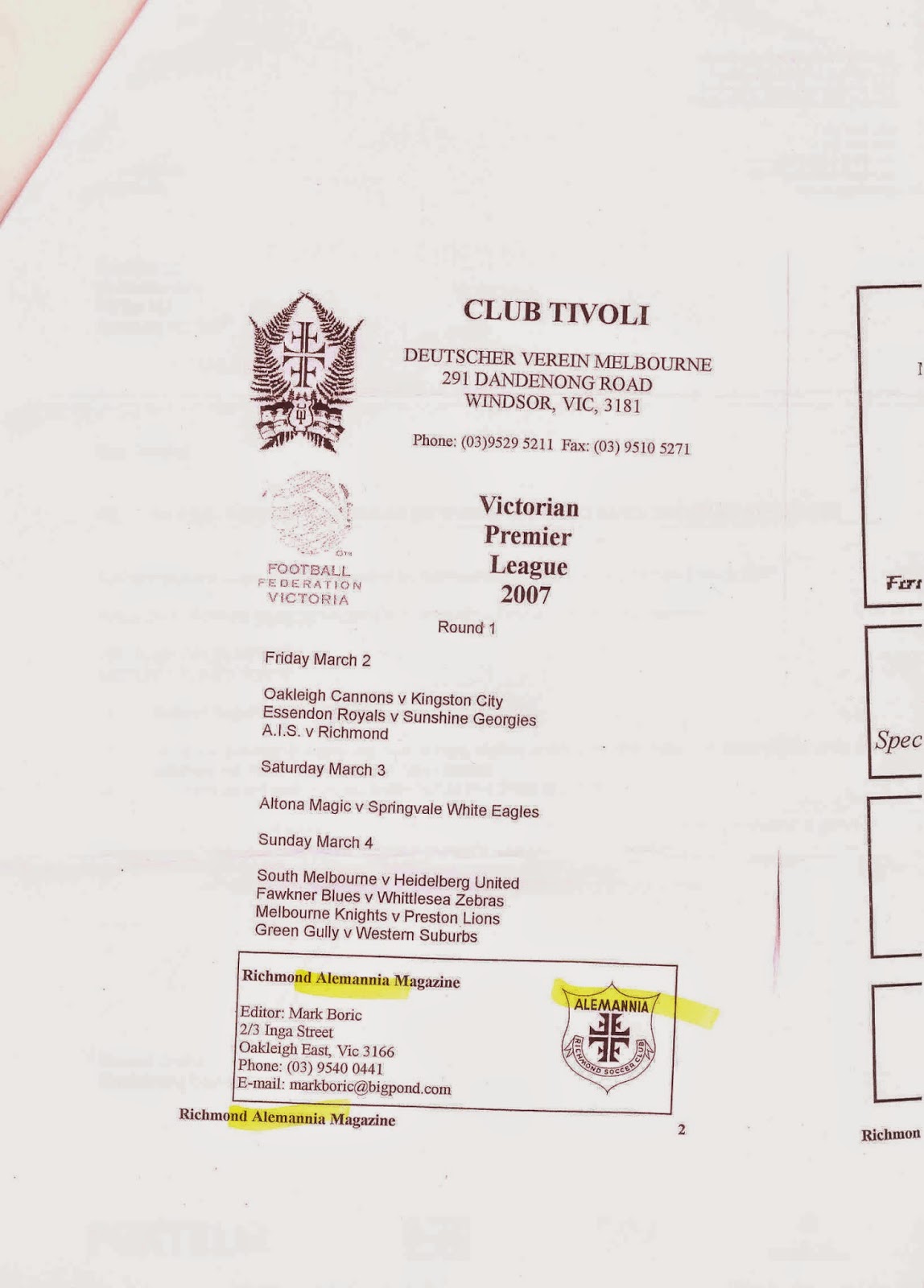
Here's an explanation from the FFV's Maxwell Gratton from 2007:


(Click on images to enlarge)

As highlighted by the FFV, the name "Alemannia" appearing alongside the club name and in the version of the club emblem was unacceptable. It poses the question as to whether the FFV discriminates against some clubs in how it enforces it's rules.

When I started Richmond Alemannia Magazine in 2002, the Alemannia name had officially been removed for many years. Even in the 1960's, the club generally appeared on league tables as just Richmond. I put the name in the title as a tribute to the tradition of the club, not in any attempt to spread German nationalism. It was as much a fanzine at times as a programme.

You may note the date on the letter is March 22nd, 2007. It arrived on the day of a home game against Essendon Royals, when 150 copies of that week's magazine had been printed and stapled. As a result of the letter, these were not allowed to be distributed. Annoying, but is any club volunteer not really wasting time that could be better spent elsewhere anyway?


So I tweeted the official FFV account to ask for an explanation. Could I be mistaken in my assumption that the rules are not being applied consistently? I'm willing to be convinced, but as yet there are no takers.

Tuesday, 10 June 2014

A Version of History


This is the blog post I've had the most difficulty in writing, and it's not just because the last time I did a book review was back at school in the late 1980's. I've struggled with how to deal with some things from a book which I largely admired and is clearly a work of great significance. 

Roy Hay and Bill Murray's A History of Football in Australia: A Game of Two Halves is certainly a grand undertaking. A game with a poorly recorded history (particularly from it's own governing bodies) clouded with so many diverging political issues, it was never going to be an easy task to sum it all up in a manner that would satisfy everyone.

The chapter on the women's game towards the conclusion is a strong one. It's a lighter read than the heavy opening to the book which deals with the how the various forms of football were codified in the late nineteenth century. Once over this necessary introduction, the book soon delves into the various struggles of the game as it spread across the colonies. The hindrance of financial depressions and World Wars give way to migrant boom times and the expulsion from FIFA. 

The book is tremendously well-researched, as one would expect from two fine academics. There are hundreds of notations. It touches on the "Code Wars" without becoming bogged down in them, which is no mean feat.

There are some great insights into the numerous breakaways from previous governing bodies and the early World Cup qualification campaigns. Throughout the book, there are some amazing photographs which really capture their time perfectly.   

A famous quote, most often attributed to Winston Churchill, is that "History is written by the victors". With that in mind it is noteworthy that the Foreword of this book is written by Frank Lowy AC, Chairman of Football Federation Australia.  

Does this mean there is a lack of balance and objectivity in sections of the book later on? One can certainly raise a few questions. In the chapter relating to the NSL it is noted that "The 1987 season began in controversy when Frank Lowy, who had been at loggerheads with the ASF about the direction the game was taking, pulled Sydney City Hakoah out of the league after the first round". It does not go on to expand on how destabilising the action was to the competition, or treat the act of spite (later it is written he "had learned and come to despise Australian soccer politics") in the same disdain later expressed at how Clive Palmer's ownership of Gold Coast United would come to an end.

Whilst much is written about the Crawford Report, no mention is made of critical elements to it yet to be implemented. Similarly whilst it is explained how the the voting structures for the State Federations were reformed to take power from top tier clubs and share it with bodies representing juniors, women's teams and refereeing bodies, little is mentioned of how the FFA no longer seems to have any elections.

The former Chairman of Soccer Australia, David Hill, though described as divisive is also portrayed rather favourably. In relation to the infamous draw with Iran which saw Australia fail to qualify for the 1998 World Cup, Terry Venables is labelled as being out-coached on several occasions. To be critical of the coach, should one be as critical of the man who appointed him? When Venables is described as erring in not bringing on Milan Ivanovic to try and hold the lead at 2-0, I can't help but think of Zoran Matic, Ivanovic's highly successful club coach at Adelaide City. The Serb Matic would have stood a better chance of being appointed Socceroos coach under any number of Croats that may have been Chairman than he did from getting the job from the famously Anglophile Hill.

Perhaps I'm making too much of these issues, but with this book likely to be the first foray into the extended history of the game in this country for many readers, it does need to be pointed out that it is just a version of history and that being definitive on such as subject is probably impossible.

Does it deserve to sit atop the pile of books about the game in Australia? It's a question, like many aspects of the sport here, that is a real political football.

Monday, 26 May 2014

The Sad State

I don't really want to write posts critical of the management of the game all the time, but what is the alternative? If you accept poor standards, you are just as complicit as those who deliver them for the sad state of affairs we find ourselves in.

A sad state it is indeed. When two Directors step down from the Board on the same day, in the same week as another CEO is turned over we are in a similar condition to the state of Denmark circa the 1500's.

To me this poses many questions. Why? What is going on? Who is to blame? Is the Board of the FFV dysfunctional? And more and more, why aren't more people demanding answers? Without any real scrutiny, it is not hard to see why the situation seems to be getting worse rather than better.

In an age when journalism increasingly seems to involve rehashing official press releases (no different to Year Seven students changing a few sentences around when copying their homework from someone else) perhaps I'm being optimistic to expect any better.

Without delving into innuendo, what we do know for sure is that:

FFV CEO Mitchell Murphy has resigned

His tenure was hardly longer than that of the previous interim appointment, Peter Gome.

FFV Director Kimon Taliadoros has tendered his resignation

From his candidacy statement we know he wanted to focus on governance. Are things that bad that he wants to disassociate himself from them after a relatively short time on the board?

FFV Director Aldrin De Zilva has also tendered his resignation

This is less surprising. Given that he is facing charges of misconduct from an Under 13's NPL fixture one may have thought that he would have been temporarily stood down immediately pending the hearing for that matter.

What adds to the intrigue in this case is that he had reported concerns about the disclosures of the financial situation of the FFV to Consumer Affairs Victoria and the Australian Securities and Investment Commission. That has given the conspiracy theorists plenty to work with.

Without a media prepared to investigate or ask the hard questions, who knows when we will get any answers? The FFA has only ever proven to put in token interest in the problems of the game at the lower end of the food chain. These issues are secondary to shifting as much Socceroos merchandise prior to the World Cup as possible. No one there must care about grass roots football. As long as Timmy Cahill's fashion gear isn't made in dodgy Asian sweatshops, there's no real scandal that would concern them.

On twitter a few weeks ago I sarcastically expressed concern that Zagame's should be the naming rights sponsor of the NPLV junior leagues.

Though billed as a family restaurant, it was the connection to gaming venues that raised my eyebrow. A week later an AFL player is arrested after a fight involving security guards in which crutches were allegedly used as weapons at their Caulfield venue. There is currently no naming rights sponsor for the senior NPLV Leagues. Even if the sponsorship deal did not meet the expectation for naming rights of the senior competition, why you wouldn't have given a chain associated with gaming and alcohol the naming rights for the senior league rather than risk the junior competition being linked with drinking, gambling and violence baffles me.

I'm also taken aback that the South Melbourne television crew should be made to assemble a scaffold gantry themselves for their fixture at Werribee this week. I would have thought that if a venue didn't meet requirements, the hosts would feel more obliged to assist in overcoming any deficiencies. Throwing someone some pipes and parts and saying "there you go" does not come up to scratch in my opinion. Especially when you have some clubs being docked points for upholding the letter of the law in terms of fielding junior teams. The old saying is "rules are rules". Under the FFV it seems that some rules matter, and others don't. How's the governance on that?

Finally, it was good to see the FFV get involved in the DON'T STAND BY. STAND UP! campaign against racism. I suppose they don't have anyone there anymore who refers to "you people" in reference to ethnic clubs?

Monday, 10 March 2014

Still a Big Swindle

Last week the FFV announced an alteration to the 2014 Fee Schedule, reducing team entry fees across the State League board. What do these reductions mean to the figures discussed in The Great Football Swindle post of February 23rd? It means that instead of taking an extra $1,046,300 from clubs this year compared to last, it will only be $863,900 more.

One hopes the extra cash would see the game managed better, but there is little improvement on that front. Already the early Dockerty Cup games have descended into farce, with forfeits once again to the fore. The FFV blames the clubs, the clubs blame the FFV. The buck (no pun pardoned) has to rest with the FFV. Just weeks after the FFA triumphantly launched the FFA Cup as the chance for grassroots clubs to take on teams at the highest level and perhaps live the dream of fairy tale upsets, what is the entry point to that competition remains a debacle.

When Fee Schedules and Rules of Competition are still being adjusted this late in the piece, it is little wonder small, amateur clubs are struggling to meet requirements. Even if it is the clubs at fault, the onus should be on the FFV to find a solution as they are the ones who suffer in comparison to bodies in other states when the situation becomes shambolic.

The question still remains, will the services to clubs improve in line with the additional revenue to the FFV coffers? Over the weekend on Twitter I noticed @FootballChaos and @Socceraust were churning out results tweets and news at a high rate.The FFV account only seems to be activated when there's a link to a new article on their website to be promoted. I dare say  Football Chaos (now there's a domain name more apt for the FFV) will once again produce better video coverage (in terms of quality, frequency and variety) than what the FFV comes up with for the NPL Victoria.

One can only imagine the folks at South Melbourne and Melbourne Knights struggling to contain their sniggering when being instructed on utilising social media by the FFV recently. Either the FFV are following the strategy of spreading the release of information out over several days (and haven't started yet), or they have very little to announce. At this stage it seems there will be radio commentary of some games via the internet, with further details still to emerge. The FFV has advertised for match reporters, and will need to increase their pool from last year when they barely had enough to cover a 6 game VPL round to be able to cover two divisions of the NPLV.

It was interesting listening on radio station SEN the day after the launch of the FFA Cup. Talkback callers quickly changed the subject to that of junior fees at NPLV clubs and their tendency towards being exorbitant. When hearing a justification of the fees/national curriculum, journalist Patrick Smith asked "are these clubs, or are they academies?". Coupled with a rare piece from Craig Foster that I actually agree with, it is clear we are entering dangerous territory. The NPLV is proving very expensive to implement, exhausting all resources to do so and then getting it wrong would prove to be a disaster that would top all those that have come before it.