Since belatedly discovering that Microsoft Paint and Microsoft Photo are a little more advanced on Windows 10 than they were on Microsoft XP over ten years ago, I thought I'd go through some documents and cut, paste, straighten and crop some old photos.
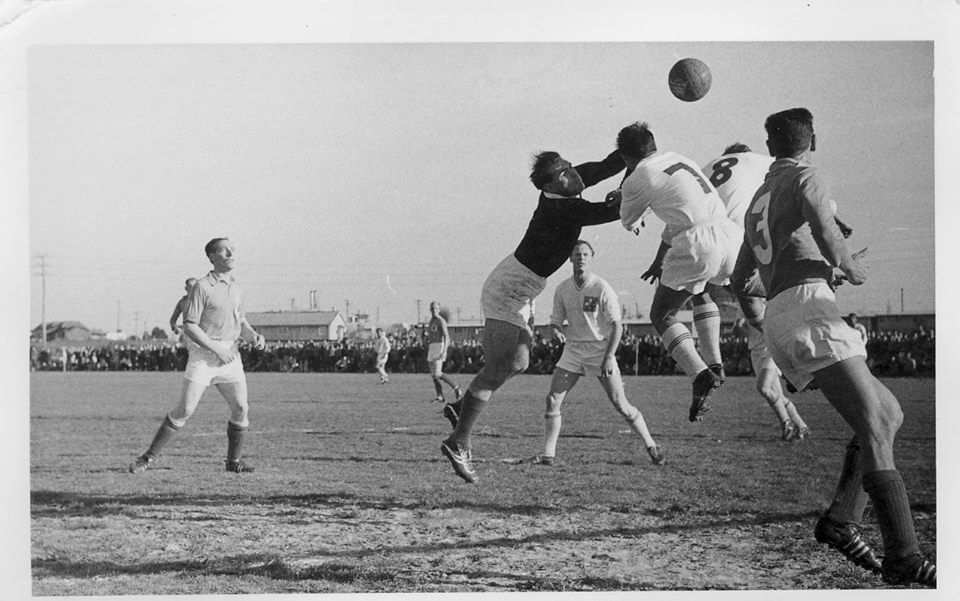
A shot from the famous 1962 VSL game between South Melbourne Hellas and George Cross at Olympic Park. The stands are a mass of humanity, as over 22,000 people crowded the venue.
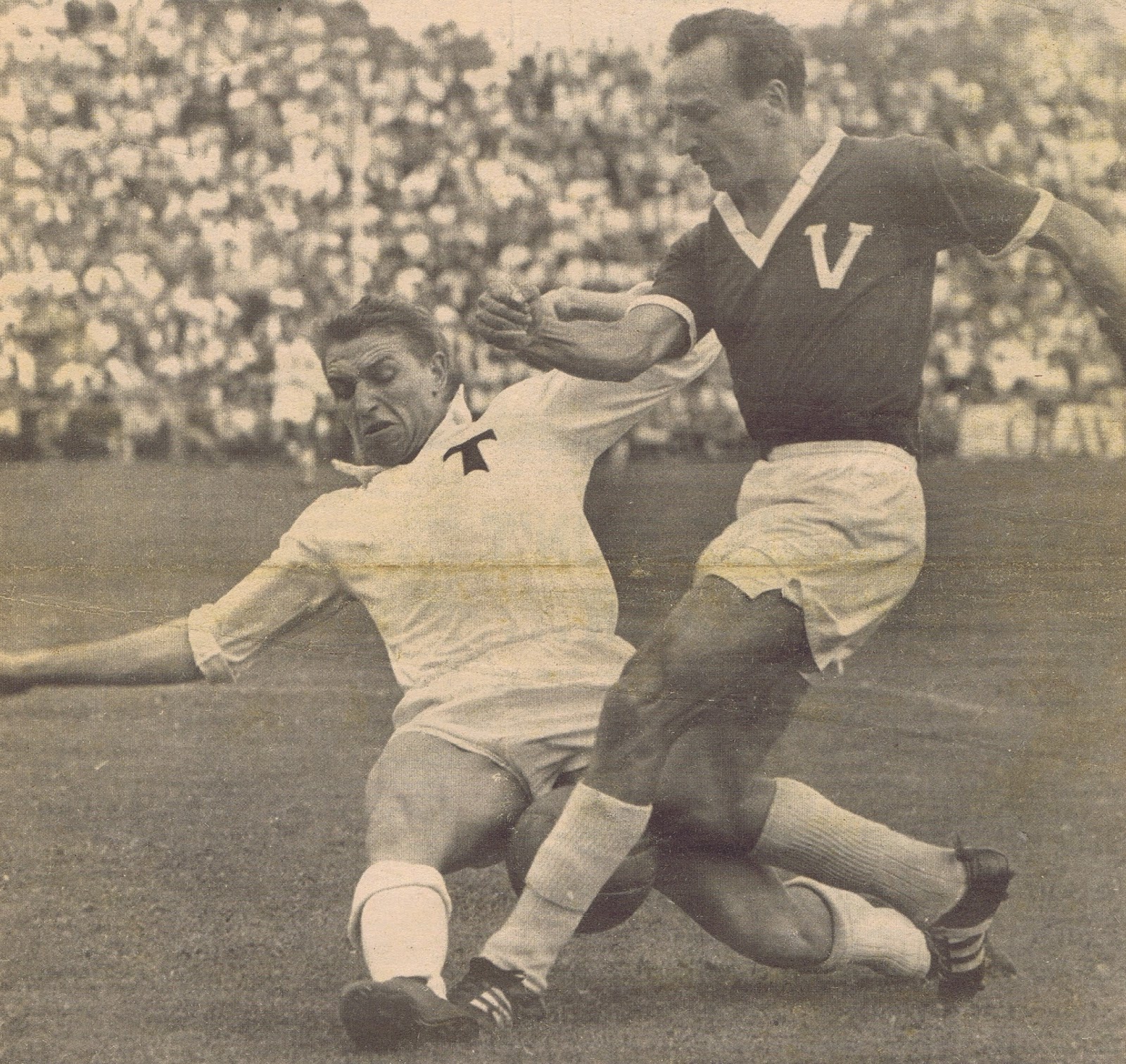
Another big crowd at Olympic Park watches Torpedo Moscow's Brednev go to ground as he tackles Victorian star Mike Jurecki in their 1965 clash.
On to another lost ground with this great wide shot of Middle Park in 1968.
Only just a star at the time, later to be a South Melbourne Hellas legend, Jimmy Pyrgolios in 1968.
A great Victorian state team from 1967. Willy Schroif, who played in a World Cup Final. Johnny Sanchez, an early Bill Fleming Medal winner. Jimmy Armstrong, goalscoring legend of Hakoah and South Melbourne Hellas who still helps out at Lakeside. Hammy McMeechan, who remained active in the game until his passing. Tommy Stankovic and Frank Micic, who were probably the two greatest ever J.U.S.T. players.
Nino Borsari, Olympic Gold Medalist, Patron of Victorian Football. A great gentleman of Carlton.
The ground remains, the grandstand does not. Action from Jubilee Park in 1963 as Layt of Ringwood Wilhelmina lead's Richmond Alemannia's Zammit to the ball in their VSL game.
Ringwood City 1982. Brooksy of the Music Men in the front row. Coached by Sjel de Bruyckere. Sjel was often referred to as Mike, but since the NCIP scandal I have amended all my records to include his proper name.
Richmond Alemannia player hi-jinx on the front page of Soccer News as Rudi van Altena holds back Peter Erasmus so Billy Copeland can cut his beard.
Prahran City team shot from 1969. Got the nod ahead of other team photographs found in Soccer News from that era simply because the goalkeeper is sporting a flat cap. You can't beat goalkeepers that wear flat caps.
(Click on images to enlarge)
Home of the Australian Football Library and the occasional thoughts about local soccer
Showing posts with label Middle Park. Show all posts
Tuesday, 31 May 2016
Sunday, 6 March 2016
Grounds of the Past: MacDonald Reserve, Hawthorn East
In another case of it's hard to believe now, humble MacDonald Reserve (now known as Burke Road South Reserve, previously also known as Hawthorn South Reserve) hosted Victorian State League football as the home of Wilhelmina in the late 1950's and early 1960's.
The ground currently has no car park of it's own. There is very limited street parking on Sinclair Avenue. There have been many changes alongside the the ground since that time, which can be appreciated when we look at the Melways map from that era.
To the north, the drive in theatre became the Coles complex at Tooronga Village. The brickworks are long gone, and to the south Carroll Crescent disappeared to make way for the South Eastern Freeway. The majority of football patrons attending games would have come via trams down Burke Road or from the Gardiner train station.
The facilities are sparse. When I visited, cricketers using the nets at the south eastern end parked on the street and had no rooms to change in. The only structures on the site are a storage shed at the north eastern end, and another building further up the hill from it, which may have been the changing rooms when the ground was a VSL venue.
The quaint building sits near the storage shed, but it may also be that the current storage shed was even the changing room back then.
The view across the pitch looking from the east to the west. Behind the trees lies Gardiner's Creek and the Monash Freeway.
With it's lack of amenities, it's the hill on the Sinclair Avenue side that would have been a major attraction to the ground for Wilhelmina as a home. It would have been able to give the crowds they were drawing a decent view, a major problem in the days when standing behind the rope on a flat open park was the prime spectator location.
Another view of the storage shed, changing rooms behind it, and the eastern side of the ground.
Looking south, towards the cricket nets. Behind that would have been the bowling clubs, and further beyond would be Gardiner railway station.
Looking east from the south western corner shows how steep the hill is, and the limited amount of street parking around the ground.
The view when looking north to where the drive in cinema would have been, which is now the corporate headquarters of the Coles supermarket chain.
The ground is in excellent condition, as you would expect in the leafy inner eastern suburbs of Melbourne. Wilhelmina began playing there when promoted to the First Division in 1957, having previously used Survey Park in Burnley (later a home of Richmond Alemannia). The club also used Olympic and Middle Parks for home games in that era, but MacDonald Reserve was chiefly their home venue until they established Jubilee Park in Ringwood in 1962. The club then changed it's name to Ringwood City Wilhelmina, eventually becoming just Ringwood City.
Could the following picture be of the game between Wilhelmina and George Cross which drew 1400 spectators to MacDonald Reserve on Saturday August 12 in 1961?
If it is, it would had to have been taken from the north eastern side. It is possible that the buildings in the background could be a part of the brickworks. It's worth further investigation, as it would be great to have an image of top flight football from this long forgotten venue.
(Click on images to enlarge)
Edited to add photo from Wilhelmina v Juventus Dockerty Cup tie in 1956
The ground currently has no car park of it's own. There is very limited street parking on Sinclair Avenue. There have been many changes alongside the the ground since that time, which can be appreciated when we look at the Melways map from that era.
To the north, the drive in theatre became the Coles complex at Tooronga Village. The brickworks are long gone, and to the south Carroll Crescent disappeared to make way for the South Eastern Freeway. The majority of football patrons attending games would have come via trams down Burke Road or from the Gardiner train station.
The facilities are sparse. When I visited, cricketers using the nets at the south eastern end parked on the street and had no rooms to change in. The only structures on the site are a storage shed at the north eastern end, and another building further up the hill from it, which may have been the changing rooms when the ground was a VSL venue.
The quaint building sits near the storage shed, but it may also be that the current storage shed was even the changing room back then.
The view across the pitch looking from the east to the west. Behind the trees lies Gardiner's Creek and the Monash Freeway.
With it's lack of amenities, it's the hill on the Sinclair Avenue side that would have been a major attraction to the ground for Wilhelmina as a home. It would have been able to give the crowds they were drawing a decent view, a major problem in the days when standing behind the rope on a flat open park was the prime spectator location.
Another view of the storage shed, changing rooms behind it, and the eastern side of the ground.
Looking south, towards the cricket nets. Behind that would have been the bowling clubs, and further beyond would be Gardiner railway station.
Looking east from the south western corner shows how steep the hill is, and the limited amount of street parking around the ground.
The view when looking north to where the drive in cinema would have been, which is now the corporate headquarters of the Coles supermarket chain.
The ground is in excellent condition, as you would expect in the leafy inner eastern suburbs of Melbourne. Wilhelmina began playing there when promoted to the First Division in 1957, having previously used Survey Park in Burnley (later a home of Richmond Alemannia). The club also used Olympic and Middle Parks for home games in that era, but MacDonald Reserve was chiefly their home venue until they established Jubilee Park in Ringwood in 1962. The club then changed it's name to Ringwood City Wilhelmina, eventually becoming just Ringwood City.
Could the following picture be of the game between Wilhelmina and George Cross which drew 1400 spectators to MacDonald Reserve on Saturday August 12 in 1961?
If it is, it would had to have been taken from the north eastern side. It is possible that the buildings in the background could be a part of the brickworks. It's worth further investigation, as it would be great to have an image of top flight football from this long forgotten venue.
(Click on images to enlarge)
Edited to add photo from Wilhelmina v Juventus Dockerty Cup tie in 1956
Sunday, 23 June 2013
In Search of... 1909
Back when I first went to research Victorian football history at the Newspaper Reading Room of the State Library of Victoria (SLV), I was aiming to one day get at least the final table of the top division each year since league football began in 1909.
I was a little lazy in my approach to this task. I went through the microfilm reels looking for the easy answers which I soon realised were not there. Head to July/August/September to find the tables did not work when the final table wasn't always published. Sometimes, just the points tally was published. It was becoming apparent that in some years, it would require recording all the results, and compiling the table myself. Then, more sadly, it was clear that for many seasons finding a record of all the results would not be happening.
So for the 1909 season, won by Carlton United, things didn't pan out. Adding up the results I'd written down made for a ridiculous ladder. So it was put on the back-burner for a few years, hoping that John Punshon at OzFootball would put something up.
Recently I began re-checking the results on the online archives of The Age and The Argus. A discovery then clarified one problem, which was having teams having played more than the 10 game season a 6 team competition should produce. The season started on Saturday May 8, and any results before that were from friendlies. So that took away the teams over 10 games, but still there were a few short, so I set off for the SLV today looking to fill the gaps.
Now we need to understand the times were different then. For the result of a Saturday sporting contest, you would need Monday's newspaper, as there were no papers published on Sundays in that time (right up until the late 1960's or early 1970's I think). The Herald was an evening paper, and did have Saturday's results in it for footy and racing, but not always for the "British Association" or "Soccer". By Monday those results were old news and often not carried.
I made a breakthrough when I discovered the day for soccer news in The Herald was actually the Friday edition. The previous week's results were often found there, gradually growing in column inches with the author's nom-de-plume, "Jackaroo" even getting a byline late in the year. On July 23rd there was even a final table, of sorts. It's not a real final table because Goals For and Goals Against are not included. It also takes the format of Wins Losses Draws rather than the modern Wins Draws Losses. I guess this was due to perhaps following along with Aussie Rules lines. After finding a few more results, I'm only two matches short (and one blurry number) from compiling a proper final table.
CARLTON UNITED 10 9 1 0 32-4 19
The goal difference is still not final, missing the scores for their wins over Fitzroy
ST KILDA 10 7 0 3 40-17 14
This is complete
MELBOURNE UNITED 10 4 0 6 16-32 8
Goal difference not final, missing the score for their win over Prahran on June 12
WILLIAMSTOWN 10 3 1 6 22-32 7
This is complete
FITZROY 10 3 1 6 14-25 7
Goal difference not final, missing the scores for their defeats by Carlton
PRAHRAN 10 2 1 7 9-22 5
Goal difference not final, missing the score for their loss to Melbourne United on June 12
So just three issues remain. A hard to read score for Carlton against Fitzroy on July 17, which is either 5 or 9 to nil. And the June 12 game between those sides as well as Melbourne United v Prahran. The Herald did give a score of Melbourne 7 Prahran 2 but the report stated it was played as a practise game for some reason the reporter did not agree with. Perhaps the result stood, but I have failed to find any mention of that. The Age and The Argus and The Leader all only have the St Kilda 10 Williamstown 0 scoreline from that day and nothing else.
All games in 1909 were played at grounds in Middle Park, except for Williamstown home games. I'm not sure if there were actual change-rooms at Middle Park, or if a room at the Middle Park Hotel was all that was used. Harry Dockerty, who donated the Cup which would eventually be named after him (called the Challenge Cup initially) was a back for runner's-up St Kilda. He also captained the Scotland side which lost 2-3 to England in the local "International" game, an annual fixture that would continue up until the 1938 contest set for July 23rd was abandoned due to lack of interest.
I was a little lazy in my approach to this task. I went through the microfilm reels looking for the easy answers which I soon realised were not there. Head to July/August/September to find the tables did not work when the final table wasn't always published. Sometimes, just the points tally was published. It was becoming apparent that in some years, it would require recording all the results, and compiling the table myself. Then, more sadly, it was clear that for many seasons finding a record of all the results would not be happening.
So for the 1909 season, won by Carlton United, things didn't pan out. Adding up the results I'd written down made for a ridiculous ladder. So it was put on the back-burner for a few years, hoping that John Punshon at OzFootball would put something up.
Recently I began re-checking the results on the online archives of The Age and The Argus. A discovery then clarified one problem, which was having teams having played more than the 10 game season a 6 team competition should produce. The season started on Saturday May 8, and any results before that were from friendlies. So that took away the teams over 10 games, but still there were a few short, so I set off for the SLV today looking to fill the gaps.
Now we need to understand the times were different then. For the result of a Saturday sporting contest, you would need Monday's newspaper, as there were no papers published on Sundays in that time (right up until the late 1960's or early 1970's I think). The Herald was an evening paper, and did have Saturday's results in it for footy and racing, but not always for the "British Association" or "Soccer". By Monday those results were old news and often not carried.
I made a breakthrough when I discovered the day for soccer news in The Herald was actually the Friday edition. The previous week's results were often found there, gradually growing in column inches with the author's nom-de-plume, "Jackaroo" even getting a byline late in the year. On July 23rd there was even a final table, of sorts. It's not a real final table because Goals For and Goals Against are not included. It also takes the format of Wins Losses Draws rather than the modern Wins Draws Losses. I guess this was due to perhaps following along with Aussie Rules lines. After finding a few more results, I'm only two matches short (and one blurry number) from compiling a proper final table.
CARLTON UNITED 10 9 1 0 32-4 19
The goal difference is still not final, missing the scores for their wins over Fitzroy
ST KILDA 10 7 0 3 40-17 14
This is complete
MELBOURNE UNITED 10 4 0 6 16-32 8
Goal difference not final, missing the score for their win over Prahran on June 12
WILLIAMSTOWN 10 3 1 6 22-32 7
This is complete
FITZROY 10 3 1 6 14-25 7
Goal difference not final, missing the scores for their defeats by Carlton
PRAHRAN 10 2 1 7 9-22 5
Goal difference not final, missing the score for their loss to Melbourne United on June 12
So just three issues remain. A hard to read score for Carlton against Fitzroy on July 17, which is either 5 or 9 to nil. And the June 12 game between those sides as well as Melbourne United v Prahran. The Herald did give a score of Melbourne 7 Prahran 2 but the report stated it was played as a practise game for some reason the reporter did not agree with. Perhaps the result stood, but I have failed to find any mention of that. The Age and The Argus and The Leader all only have the St Kilda 10 Williamstown 0 scoreline from that day and nothing else.
All games in 1909 were played at grounds in Middle Park, except for Williamstown home games. I'm not sure if there were actual change-rooms at Middle Park, or if a room at the Middle Park Hotel was all that was used. Harry Dockerty, who donated the Cup which would eventually be named after him (called the Challenge Cup initially) was a back for runner's-up St Kilda. He also captained the Scotland side which lost 2-3 to England in the local "International" game, an annual fixture that would continue up until the 1938 contest set for July 23rd was abandoned due to lack of interest.
Subscribe to:
Posts (Atom)